

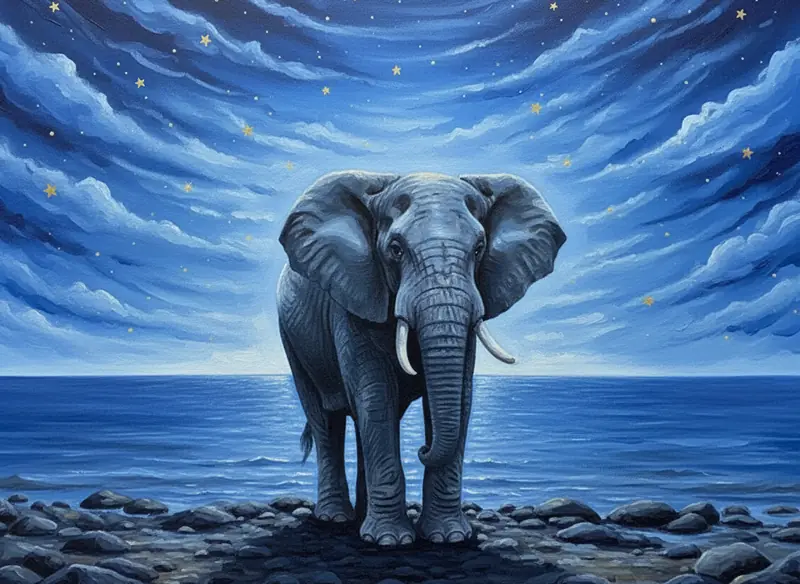
Key takeaways
- Elephant dreams usually speak of strength, memory, patience or a burden you carry.
- The animal's behaviour and your feeling decide the meaning, not the species.
- A calm elephant tends to read as protection; a charging one as a problem you keep postponing.
- In Hindu and Buddhist tradition the elephant is a sacred, lucky animal; the Bible barely mentions it.
- No research shows that any dream animal predicts money, luck or pregnancy.
Your dream
A reflection, not a prediction
You’ve had today’s free interpretation on this browser. Sign up with Apple or Google to keep it and get more.
Read the full interpretation — free
This is the first part of your interpretation. Create a free account to read the rest.
Sign up and this dream and its interpretation are saved to your journal. Otherwise they’re deleted in 24 hours. No card, no subscription.
On this page
What do elephant dreams mean?
An elephant in a dream is hard to ignore, and that is often the point. Across folklore, religion and psychology, the same handful of readings return when people describe an elephant dream. Start with the one that matches how the dream felt.
Strength and steadiness
The largest land animal moves slowly and gets where it wants. A calm elephant can mirror your own stamina, or a person in your life who holds things together.
Memory and the past
"An elephant never forgets" is a saying for a reason. The animal can stand for something you remember too well: an old hurt, a promise, a person you have not let go.
A weight you carry
Responsibility, debt, caregiving, grief. When the elephant feels heavy or blocks your path, the dream may be showing you a load you have stopped noticing.
The thing nobody names
"The elephant in the room" lives in dreams too. An animal standing in your kitchen or office can be the problem everyone sees and nobody mentions.
These readings overlap. A herd walking past a watering hole feels nothing like a bull charging through your house. The sections below cover the details that change the meaning.
Why elephants appear in dreams
Many people who dream about elephants have never stood near one. Dream research gives a few plain explanations.
Dreams continue your waking life
G. William Domhoff calls it the continuity hypothesis: dreams borrow from what occupies you by day. A documentary, a child's toy, a phrase like "elephant in the room" or a news story can plant the image. The emotion attached to it is yours.
Big animals make good metaphors
Animals are common dream characters, especially in children's dreams, and the larger ones tend to carry the dreamer's sense of scale. When a problem feels too big to move, the sleeping brain may pick the biggest creature it knows. The same logic puts a lion or a bear in dreams about power and threat, and a mouse in dreams about feeling small.
Emotion processing
Sleep researcher Matthew Walker describes REM sleep as a kind of overnight therapy that softens the charge of difficult memories. A dream in which a heavy animal finally moves, or lets you climb on, may belong to that process.
What to notice in your elephant dream
Two people can both dream of an elephant and need different readings. Before you look up a scenario, answer these questions:
- What was it doing? Walking, standing still, charging, bathing, dying, carrying you.
- How big was it compared with you? Normal, tiny, giant.
- How did you feel? Awe, calm, fear, pity, affection.
- Where were you? Savannah, your house, a city street, a circus, water.
- Who else was there? Your partner, your family, a stranger, a child.
- What is heavy in your life right now?
If the elephant were a person, a task or a feeling, which one would it be?
Elephant dream scenarios at a glance
| Dream | What it often reflects |
|---|---|
| A calm elephant walking or grazing | Stability, patience, someone protective |
| An elephant chasing you | A large problem you keep avoiding |
| Riding an elephant | Confidence, feeling in control of something big |
| Hugging or touching one | A need for comfort, trust in someone steady |
| A baby elephant | New responsibility, tenderness, something that will grow |
| A herd | Family ties, community, loyalty |
| A dead or dying elephant | The end of a long chapter, lost strength, grief |
| An elephant in your house | A family matter nobody talks about |
| An elephant in water | Emotions handled with care; cleansing |
| A tiny or shrinking elephant | A worry that looks smaller than you feared |
A calm or friendly elephant
The gentle version is one of the elephant dreams people describe most. The animal walks, eats, sprays water, lets you come near. Dreamers usually wake up calm or even moved.
This dream tends to appear when something in your life is steadier than you give it credit for: a relationship that holds, a routine that works, a body that recovered. It can also point to a person, often an older relative or mentor, whose quiet presence you rely on. If the animal looked at you, ask what that steady gaze would say.
A friendly elephant that follows you around works like a loyal dog in dreams: a reminder of support you may be taking for granted.
An elephant chasing or attacking you
A charging elephant is one of the frightening versions, and it follows the pattern of all chase dreams. Antti Revonsuo's threat simulation theory suggests that dreams rehearse danger in a safe setting; being chased is one of the most common dream themes worldwide.
What makes the elephant different from a tiger or a snake is the slowness and the size. You usually see it coming. Many dreamers describe knowing the animal would reach them and being unable to move. That matches a waking situation you can see approaching but keep postponing: a deadline, a conversation, a diagnosis, a bill.
An elephant that attacks your house or your car often brings the threat closer to home or to your sense of control. An elephant trampling a crowd can reflect anger, yours or someone else's, that feels too big to manage.
Riding, touching or hugging an elephant
Riding an elephant in a dream is usually a good feeling: high up, moving steadily, the strength under you working with you. Unlike a horse, the animal sets the pace. It can appear around promotions, recoveries and moments when a long effort finally pays off. If the ride felt unstable, the dream may be asking whether you are in charge of the thing you are steering, or only sitting on it.
Touching the skin, feeding the animal or hugging its trunk belongs to a different register: comfort. It often appears when you want someone solid to lean on, or when you are the solid one and need a rest. People grieving a parent sometimes describe this dream.
A baby elephant, a herd or many elephants
A calf changes the tone of the whole dream. A baby elephant tends to reflect something small that will become large: a new project, a baby or pregnancy in the family, a responsibility you are only starting to feel. It can also stand for your own vulnerability inside a strong exterior. A sick or malformed calf usually shows worry about something fragile that you are supposed to protect.
A herd points outward, to the group you belong to. Elephants live in close family units led by older females, and dreamers often describe herds when they are thinking about loyalty, people who depend on them, or the distance between themselves and their relatives. Many elephants crowding a small space can reflect too many obligations at once.
Elephant colours: white, black, blue and grey
Colour carries meaning in dreams the way it does in language. The elephant's shade is worth noting, even if most dreamers only remember "grey".
| Colour | Common reading |
|---|---|
| Grey | The ordinary animal; focus on its behaviour instead |
| White | Rarity, purity, a sacred or lucky sign in Asian tradition; also a "white elephant", a costly thing you cannot give away |
| Black | Grief, the unknown, an unspoken weight |
| Blue | Calm, melancholy, a storybook or childhood feeling |
| Pink or multicoloured | Playfulness, or the toy animal you grew up with |
A white elephant deserves a second look. In Thailand, Myanmar and Buddhist stories it is auspicious. In English, a white elephant is a possession that costs more than it gives. Both meanings can fit the same dream, depending on whether the animal felt like a gift or a burden.
Where the elephant was
Setting changes the reading of an elephant in a dream as much as its behaviour does.
In your house
The biggest version of the elephant in the room. A family issue, a secret, a decision that affects everyone and that nobody raises at dinner. Notice which room it occupied: the kitchen often points to daily life, the bedroom to intimacy.
In water
Elephants bathe and swim well. An animal wading into a river or the sea mixes strength with emotion. For many dreamers it reads as handling feelings with care, or as cleansing after a hard stretch. Rough water, a flood or an elephant drowning pushes the dream toward being overwhelmed. See the water page for more.
In a city, a zoo or a circus
Out of place, controlled or performing. These dreams often reflect feeling too large for your current role, or doing tricks for an audience at work. A chained animal is a common image for talent or anger held back.
In the wild
Herd, savannah, dust, a lone tree on the horizon. Usually the calmest version, and the one most tied to freedom, nature and a sense of proportion. A herd fleeing a fire or a storm turns that calm into alarm.
A dead, injured or dying elephant
A dead elephant is a heavy image and often arrives in heavy seasons. It can mark the end of something that lasted a long time: a career, a marriage, a parent's life, a belief you were raised with. It can appear while you care for an ageing relative, or after you have lost one.
Hunting, tusks and ivory add a layer of injustice. A poached animal can reflect something valuable taken from you, or guilt about a gain that cost someone else. If you were the one hurting it, the dream may be asking what strength in yourself you are trying to destroy. Read the death page for how dreams handle endings in general; the imagery is rarely literal.
Spiritual meaning of an elephant in a dream
Many people search for the spiritual meaning of elephants in dreams, and the animal has one of the richest symbolic histories of any creature.
- In Hindu tradition, Ganesha has an elephant's head and is honoured as the remover of obstacles and the patron of beginnings. Seeing an elephant is considered a blessing, and many dreamers from Hindu families read the dream as encouragement before a new venture. The link to gods and sacred figures in dreams is strong here.
- In Buddhist tradition, Queen Maya dreamt of a white elephant before the birth of the Buddha. The white elephant became a symbol of wisdom, patience and mental strength.
- In Thailand and across Southeast Asia, the animal is a royal emblem and a national symbol.
- In many African traditions, the elephant stands for wisdom, longevity and chiefly authority. Proverbs about it are common across the continent.
- In Western esoteric writing, it is tied to memory, loyalty and the slow, grounded energy of the earth. Some writers treat it as a spirit animal of protection.
As with every tradition on this site, these are readings people have given the animal over centuries, not facts about your future. They can still be useful: if the elephant felt like a blessing, the dream probably touched something you value.
Biblical meaning of an elephant in a dream
The Hebrew Bible and the Protestant canon never mention elephants directly; ivory appears several times as a sign of wealth, as in Solomon's throne (1 Kings 10:18). Elephants appear only in 1 Maccabees, part of the Catholic and Orthodox canon, as war animals in the Seleucid army. Because of that, there is no settled biblical meaning of elephants in dreams. Christian writers who interpret the dream usually borrow general themes: strength given by God, patience, the burden of sin or responsibility, and the warning in Proverbs against pride, which fits a trampling animal.
In Islamic tradition the picture is different. The Quran has a chapter called Al-Fil, "The Elephant", about an army with elephants that failed to destroy the Kaaba. Early Muslim dream interpreters such as Ibn Sirin often read the animal as a powerful ruler or a large undertaking, favourable when calm and unfavourable when hostile. Dreamers from Jewish tradition sometimes point to the Talmud, where seeing an elephant in a dream is said to mean that wonders will happen to you.
Is dreaming of an elephant good or bad?
Many dream traditions call it a good omen, and many dreamers wake from it feeling fine. Psychologically, the sign is neither. The animal is a container: calm elephants hold strength and protection, hostile ones hold avoidance and fear, dead ones hold loss.
People also ask whether an elephant dream means money, luck or a pregnancy. There is no evidence that dreams predict any of these. Folklore in India and parts of Africa does tie the animal to prosperity, and popular dream books read a herd walking toward you as good fortune. Treat that as a pleasant frame, not a forecast, and do not change financial plans on the strength of a dream about money or an elephant.
Elephants, work and the weight you carry
Elephant dreams can turn up on a Sunday night or before a big meeting. The animal fits the feeling of a job that asks for stamina more than brilliance, or a role where you are the one who never drops anything. Dreams about hauling, loading or leading an elephant through a narrow gate often belong to people managing teams, caring for others or running a household alone.
If that is you, the dream is not telling you to put the load down. It is noticing that the load exists. That alone can be useful information on a Monday morning. The body often shows up in these dreams too, as exhaustion or as physical strength you had forgotten.
Recurring elephant dreams and what to do
A pleasant elephant dream needs nothing. A frightening or sad one that repeats deserves attention, less for what it predicts (nothing) than for what it points at.
- Write the dream down on waking, including the animal's mood and your own.
- Name the heavy thing. If the elephant were a situation, which one is it?
- Take one concrete step toward it during the day. Chase dreams may fade once you stop avoiding.
- If the dreams are nightmares that disturb your sleep for weeks, imagery rehearsal therapy and similar methods are well studied and effective. A sleep clinic or therapist can help.
- Grief dreams, including dead or crying animals, are a normal part of mourning and usually soften with time.
Questions people ask
What does it mean to dream of an elephant?
It most often reflects strength, patience, memory or a burden you carry, depending on what the animal did. A calm elephant points to steadiness and protection, a charging one to a large problem you keep avoiding, a dead one to the end of a long chapter. Your feeling in the dream is the best guide to which reading fits.
What is the spiritual meaning of an elephant in a dream?
In Hindu tradition the elephant is linked to Ganesha, who removes obstacles and blesses beginnings. In Buddhism a white elephant announced the Buddha's birth and stands for wisdom and patience. African traditions tie it to longevity and authority. These are symbolic readings, not predictions, but they explain why so many people wake from this dream feeling encouraged.
Is an elephant in a dream good or bad?
Many traditions call it a good sign, and many dreamers remember it kindly. Psychologically the animal is neutral: it carries whatever feeling the dream gave it. A calm, friendly animal reflects support; an aggressive one reflects fear or avoidance; a dying one reflects loss. Judge the dream by its mood, not by the species.
What does a baby elephant mean in a dream?
A calf usually stands for something small that will grow: a new responsibility, a project, a child or a tender part of yourself. It can appear when you are expecting, starting a business or caring for someone young. A sick or hurt calf tends to reflect worry about something fragile you are supposed to protect.
What does it mean when an elephant chases you in a dream?
Chase dreams rehearse threat, and the elephant makes the threat large and slow, something you see coming. Most people connect it to a situation they have been postponing: a hard conversation, a debt, a decision, a health check. Taking one real step toward that situation is a practical way to take the charge out of the dream.
What does riding an elephant in a dream mean?
Riding usually feels good and reflects confidence, control of something big, or a long effort that is finally moving. If the ride was unstable or the animal ignored your directions, the dream may be asking whether you are really steering the situation you are sitting on.
What is the biblical meaning of an elephant in a dream?
The Protestant Bible never names the elephant; only ivory appears, as a sign of wealth. Elephants appear as war animals in 1 Maccabees, in Catholic and Orthodox Bibles. Christian interpreters therefore borrow general themes such as God-given strength, patience and a warning against pride. The Quran has a chapter called "The Elephant", and classical Islamic interpreters read the animal as a powerful ruler or large undertaking. The Talmud says seeing one in a dream foretells wonders.
What does a white elephant mean in a dream?
Two meanings sit side by side. In Thai and Buddhist tradition the white elephant is sacred and lucky, a sign of wisdom. In English, a white elephant is a costly possession nobody wants. Ask whether the animal in your dream felt like a gift or like a burden; that tells you which reading fits.
Does dreaming of elephants mean money or luck?
No dream predicts money, luck or pregnancy, and there is no research showing otherwise. Indian and some African folk traditions do associate the animal with prosperity, and many dreamers enjoy that frame. Enjoy it, but do not make financial decisions because of a dream.
The bottom line
An elephant dream usually points at something large and lasting: your own strength, a memory you cannot put down, a responsibility you carry, or the issue everyone avoids naming. Calm elephants tend to reflect stability and protection; charging ones a problem you can see coming; dead ones the end of a long chapter. Hindu, Buddhist and many African traditions treat the animal as sacred and lucky, while the Bible barely mentions it. No dream predicts money or luck. The useful question is simple: what in your life right now is as big, slow and impossible to ignore as that animal?

Clinical psychologist in private practice in Minnesota who works with adults on anxiety, stress and sleep problems, including recurring nightmares.
Sources
- Domhoff, G. W. (2003). The Scientific Study of Dreams. American Psychological Association.
- Revonsuo, A. (2000). The reinterpretation of dreams: An evolutionary hypothesis of the function of dreaming. Behavioral and Brain Sciences.
- Walker, M. P., & van der Helm, E. (2009). Overnight therapy? The role of sleep in emotional brain processing. Psychological Bulletin.
- Krakow, B., & Zadra, A. (2006). Clinical Management of Chronic Nightmares: Imagery Rehearsal Therapy. Behavioral Sleep Medicine.
- Jung, C. G. (1964). Man and His Symbols.