

Key takeaways
- Alligator dreams most often point to hidden danger, aggression, fear of being caught off guard or emotions held under the surface.
- The same reptile can stand for patience, strength and fierce protection.
- What the animal did and how you felt decide the meaning more than its colour or size.
- The Bible never mentions alligators; biblical readings borrow from Leviathan and crocodile imagery.
- No research shows that dreams predict attacks, money or luck.
Your dream
A reflection, not a prediction
You’ve had today’s free interpretation on this browser. Sign up with Apple or Google to keep it and get more.
Read the full interpretation — free
This is the first part of your interpretation. Create a free account to read the rest.
Sign up and this dream and its interpretation are saved to your journal. Otherwise they’re deleted in 24 hours. No card, no subscription.
On this page
What does an alligator dream mean?
An alligator in a dream rarely carries one fixed message. When people look up an alligator dream meaning, they usually want to know whether the dream is a warning. In most cases it reflects something you already feel. Dream interpretation across psychology and folklore tends to land on five readings.
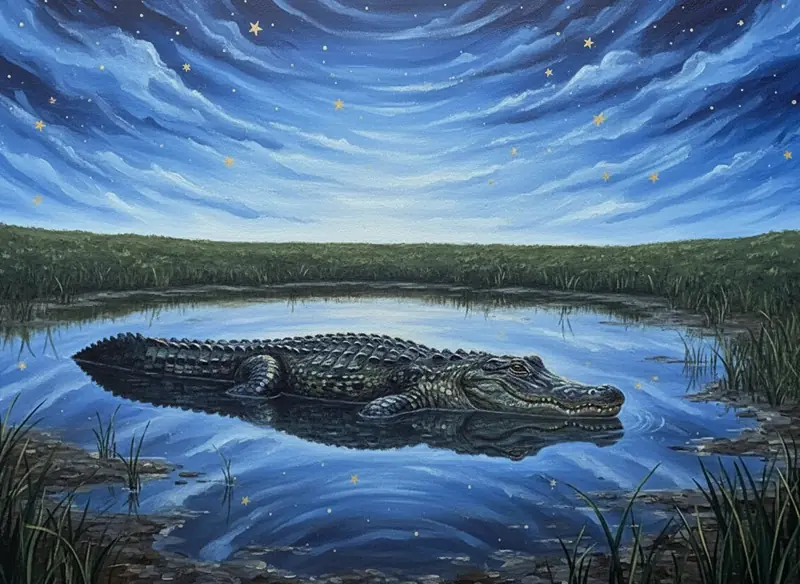
- Hidden danger. The reptile waits motionless with only its eyes above the water. The dream may echo a risk you sense but cannot see.
- Aggression. Your own anger, or someone else's, that can snap shut fast.
- Being caught off guard. Fear of a surprise attack: criticism, a layoff, a betrayal.
- Deep emotion. Feelings kept under the surface, ready to rise.
- Patience and survival. Crocodilians have kept much the same shape for tens of millions of years, and they survive by waiting and saving energy.
The readings overlap. A sleepy alligator on a riverbank feels nothing like one lunging at your leg. Compare it with other animal dreams and you will see the same rule: the feeling comes first. A snake dream shares the sense of hidden threat, while a turtle, another reptile, leans toward slowness and shelter.
Why alligators show up in dreams
Alligators in dreams may appear more often for people who live near them, in Florida or Louisiana for example, or who recently saw one on TV, at a zoo or in the news. They also appear in the dreams of people who have never seen one outside a screen. A few research ideas explain why.
Dreams continue your day
G. William Domhoff and other researchers describe a continuity between waking life and dreaming: people, worries and feelings from the day return at night. Michael Schredl and Friedrich Hofmann found that waking activities show up in dreams in a measurable way. A documentary about swamps, a vacation near a lake or an argument with someone "snappy" can all feed a gator dream.
Dreams rehearse threats
Antti Revonsuo's threat simulation theory proposes that dreams let us practise facing danger in a safe setting. A large predator that hides in water and strikes without warning is an almost perfect training scene. Dreams of being chased work in a similar way.
Dreams process emotion
Matthew Walker and Els van der Helm suggest that REM sleep helps the brain handle emotional experiences. Fear and anger are both strong emotions, and few images capture sudden aggression as clearly as a set of jaws.
What to notice before you interpret
Two people can both dream about alligators and need different readings. Before you check a scenario, answer these questions.
- What was the alligator doing? Resting, watching, swimming, chasing, biting, dying.
- Where was it? A swamp, a river, a pool, your house, a street.
- How big was it? A hatchling or a giant.
- How did you feel? Afraid, calm, curious, protective, angry.
- Who else was there? A child, a partner, a coworker, a stranger.
- What in your life feels risky, tense or unpredictable right now?
A helpful test: if the alligator in your dream were a person or a situation, who or what would it be?
Alligator dream scenarios at a glance
| Dream | What it often reflects |
|---|---|
| Alligator bite | A hurt that already happened, often a harsh word or a betrayal |
| Alligator attack | A conflict that feels sudden and personal |
| Alligator chasing you | Something you avoid that is catching up |
| Baby alligator | A small problem that could grow, or a new, fragile strength |
| Killing an alligator | Facing a fear, ending a threat, taking control |
| Saving an alligator | Protecting a part of yourself or someone others fear |
| Hugging an alligator | Getting close to a risky person or accepting your own anger |
| Buying an alligator | Taking on a risk on purpose, a deal you are unsure about |
| Alligator in water | Emotions moving below the surface |
| Alligator in the house | Tension at home or in a close relationship |
| Dead alligator | A threat that has passed, or strength you set aside |
Dreaming of an alligator attack or bite
An attack is the scene people search for most. In a dream where the reptile attacks, the threat feels close and personal: a confrontation at work, a family argument, someone who suddenly turned hostile. An alligator bite goes one step further. The harm has already happened.
Where the bite lands can matter. A bite on the leg or foot often connects to your plans and ability to move forward. A bite on the arm or hand connects to work and what you do. If the animal dragged you into the water, the dream may reflect being pulled into someone else's drama, much like a dream of drowning. If you saw blood, the hurt likely feels fresh.
When the alligator attacks someone else in your dream, it often shows worry for that person, or fear that a conflict around you will spread. It does not mean the person is in danger.
Being chased by an alligator
Alligators on land move faster in short bursts than most people expect, and the dreaming mind knows that. Dreams about alligators chasing you usually point to something you have been putting off: a conversation, a bill, a decision. The longer you run, the bigger the reptile tends to get.
Try to recall whether you escaped. Getting away, climbing a tree or shutting a door often reflects a coping strategy you already have. Turning to face the animal in the dream is a picture of courage that you can use while awake.
Alligators in water, pools and floods
Water in dreams is closely tied to emotion. Our page on water dreams covers this in detail. An alligator hidden in dark water shows feelings or risks you cannot see clearly. In clear water you can see the danger, which means you probably already know what the problem is.
- In a swamp or river: old, murky emotions, something that has been around for a while.
- In a swimming pool: a threat in a place meant for leisure or family, for example tension during holidays or at home.
- In a flood: emotions spilling over, with the gator as the danger that comes with them.
- Next to fish or frogs: a scene of ordinary life where one element feels threatening.
Alligator in your house
A house in a dream often represents yourself, your family or your sense of safety. An alligator inside it suggests that a threat has come very close: a tense relationship, a roommate conflict, anger in the family that nobody names. The room matters. In the bathroom it can relate to privacy or the body; in the bedroom to intimacy and trust; in the kitchen to care and daily routines.
If you calmly led the reptile out of the house, the dream may show that you are ready to set a boundary.
Baby alligators and giant alligators
Size usually tracks how big the problem feels. A huge alligator, longer than a car, often reflects a worry that has grown out of proportion: debt, a health fear, a toxic workplace. A giant gator you watch from a safe distance can show respect for a powerful person or force in your life.
A baby alligator is two-sided. It may be a small problem now that could grow if ignored. It may also be a new strength, a protective instinct or a creative idea in its early stage. Dreams of a baby together with an alligator can reflect fierce protectiveness toward someone you care for. Real alligator mothers guard their nests and carry hatchlings to water in their jaws, an image some readers link to protective love.
Killing an alligator or seeing one dead
Killing an alligator in a dream is often a picture of taking control. You face a fear, end a draining situation or stand up to a bully. If the dream felt violent or you felt guilty, our page on killing someone in a dream explains why such images are common and rarely literal.
A dead alligator can mean a threat has passed. It can also mean you shut down your own anger or assertiveness so completely that you now feel defenceless. Ask which of the two fits. If death imagery keeps returning, it usually points to an ending in your life, not to anyone dying.
What the alligator's colour can mean
Colour is a smaller detail than action or feeling, but it comes up often.
| Colour | Common reading |
|---|---|
| Green alligator | The classic gator: nature, instinct, a threat that blends in |
| Gray alligator | An older, quieter problem, routine stress |
| Brown alligator | Practical concerns: home, work, money |
| Red alligator | Anger, passion or a conflict heating up |
| Yellow alligator | Caution, anxiety, or envy |
| Blue alligator | Sadness, distance, or calm around a danger |
| Turquoise alligator | Healing, clear communication around a hard topic |
| Gold alligator | Ambition, value, or a risky opportunity |
| Silver alligator | Intuition, something valuable inside a threatening situation |
Personal associations beat any table. If you grew up near a bayou, a gator may feel ordinary to you and carry less fear than it does for others.
Alligator or crocodile: does the difference matter?
Many people are not sure which reptile they saw. In nature, alligators have a broad, U-shaped snout, while crocodiles have a narrower, V-shaped one, and a crocodile's lower teeth show when its mouth is closed. Alligators live mostly in fresh water in the southeastern United States and in China.
In dreams the difference is small. Both stand for hidden danger, survival and instinct. Some readers see the crocodile as slightly more aggressive and ancient, partly because of its role in Egyptian and biblical imagery. Our page on alligator or crocodile dreams covers this choice in more detail.
Alligator dreams at work and in relationships
In a job dream, an alligator often stands for a colleague or boss who seems calm but can snap, or for a company culture where mistakes are punished hard. These dreams tend to come up during reviews, layoffs or office conflict.
In relationships, a gator can stand for a partner whose anger feels unpredictable, or for your own temper. If the alligator was tame in the dream, you may be learning to live with a strong personality. Dreaming of other powerful predators, such as a tiger, lion or bear, often belongs to the same theme of power and control between people.
Is an alligator dream good or bad?
Most alligator dreams feel tense, but tense does not mean bad. Many dream readings treat the reptile as a warning, and in a sense it is: the dream points to a risk or emotion you may be ignoring. Noticing it is useful.
There are good readings too. Alligators are patient and resilient. A dream where you watch one calmly, swim beside it without harm or save it can reflect your own strength, self-control or ability to wait for the right moment. Neither psychology nor any dream dictionary gives one answer here, so take each reading as a question.
Spiritual meaning of alligators in dreams
The spiritual meaning of an alligator varies by culture.
- In ancient Egypt, Sobek was a crocodile-headed god linked to the Nile, fertility and protection. Crocodiles there inspired both fear and reverence.
- In many Indigenous traditions of the Americas, alligators and caimans appear in stories as guardians of water and as ancient beings.
- In modern spiritual readings, the gator is often called a symbol of primal energy, patience, and the boundary between conscious life (land) and the unconscious (water).
Spiritual readings work best as prompts. Ask what the tradition's picture of this reptile stirs up in you, instead of taking it as a prediction.
Biblical meaning of an alligator dream
The Bible does not mention alligators, which are native to the Americas and China. People searching for an alligator dream meaning in the Bible usually turn to crocodile-like imagery. In Job 41, Leviathan is a fearsome creature of the waters that no human can tame, and many readers picture it as a giant crocodile. In Ezekiel 29, Pharaoh of Egypt is described as a great monster lying in his rivers, an image often linked to the Nile crocodile.
In Christian tradition, these passages make the reptile a symbol of pride, chaos and powers that oppose God, and also of God's greater power over them. Some believers read an alligator dream as a call to watch for pride or a hostile influence, or as a reminder that no threat is beyond God. If faith matters to you, our page on God in dreams looks at religious images more broadly.
Alligator nightmares and how to cope
Waking from an alligator nightmare with a racing heart is common. Ross Levin and Tore Nielsen's research on disturbed dreaming connects frequent nightmares with stress and emotional distress, not with any personal weakness.
What helps:
- Write the dream down, along with what happened the day before.
- Name the main feeling in one word: fear, anger, helplessness.
- Rehearse a new ending while awake. Imagery rehearsal therapy, studied by Barry Krakow and Antonio Zadra, has you rewrite a recurring nightmare and practise the new script.
- Wind down before bed and avoid intense nature documentaries or horror films late at night.
If nightmares come several times a week, follow a trauma or keep you from sleeping, talk to a doctor or therapist.
Questions people ask
What does it mean to dream about an alligator?
Dreaming about an alligator usually reflects hidden danger, aggression, fear of being caught off guard or deep emotions you keep under control. It can also stand for patience and resilience. What the reptile did, where it appeared and how you felt matter most. These details link the dream to a specific situation, such as a tense relationship or a risky decision.
Is an alligator dream a bad sign?
No. It may feel threatening, but it is not an omen. An alligator in a dream often marks a concern you have been ignoring or a conflict you sense coming. Seeing it clearly in the dream gives you a chance to deal with it while awake. No study shows that dreams predict misfortune.
What does it mean when an alligator attacks you in a dream?
An attack usually reflects a conflict that feels sudden and personal: criticism, a fight, a person who turned on you. The part of your body involved can add detail, with legs often linked to plans and hands to work. If you escaped or fought back, the dream may show that you have the resources to cope.
What is the biblical meaning of alligators in dreams?
The Bible does not mention alligators. Christian readers usually draw on Leviathan in Job 41 and the river monster in Ezekiel 29, both often pictured as crocodiles. From these, the reptile came to symbolize pride, chaos and hostile powers, along with God's power over them. Some believers take the dream as a call to reflection.
What is the spiritual meaning of an alligator?
In spiritual readings the alligator often stands for primal energy, patience and the meeting point of land and water, which some read as the conscious and unconscious mind. In ancient Egypt the crocodile god Sobek was linked to protection and fertility. These meanings are cultural, not predictions, so use them as questions about your life.
What does a baby alligator in a dream mean?
A baby alligator can point to a small problem that may grow if ignored. It can also represent a new strength, a protective instinct or an idea in its early stage. How you felt matters. Fear suggests a concern you should address soon, while tenderness suggests you are caring for something fragile in yourself or someone else.
Is dreaming of an alligator different from dreaming of a crocodile?
Only slightly. Both reptiles stand for hidden danger, instinct and survival. Some interpreters see the crocodile as more aggressive and ancient, partly because of Egyptian and biblical imagery, while the alligator feels closer to swamps and everyday life in the American South. Your own associations with each animal count more than the zoology.
Why do I keep dreaming about alligators?
Recurring dreams often follow ongoing stress. If the same worry stays unresolved, the dreaming mind returns to the same image. Exposure plays a role too: living near lakes with gators, a recent trip or a news story can bring them into your dreams. Writing the dreams down and noting what happened the day before often reveals the pattern.
The bottom line
An alligator dream usually points to a risk below the surface, aggression close by or emotions you keep under tight control. Sometimes it shows the opposite: patience, protection and the strength to survive. Look at what the alligator did, where it appeared and how you felt, then ask which part of your waking life matches. The reptile is rarely literal and does not forecast events. If the dream returns often, treat it as a sign to address stress, not as something to fear.

Clinical psychologist in private practice in Minnesota who works with adults on anxiety, stress and sleep problems, including recurring nightmares.
Sources
- Domhoff, G. W. (2003). The Scientific Study of Dreams. American Psychological Association.
- Schredl, M., & Hofmann, F. (2003). Continuity between waking activities and dream activities. Consciousness and Cognition.
- Revonsuo, A. (2000). The reinterpretation of dreams: An evolutionary hypothesis of the function of dreaming. Behavioral and Brain Sciences.
- Walker, M. P., & van der Helm, E. (2009). Overnight therapy? The role of sleep in emotional brain processing. Psychological Bulletin.
- Levin, R., & Nielsen, T. A. (2007). Disturbed dreaming, posttraumatic stress disorder, and affect distress. Psychological Bulletin.
- Krakow, B., & Zadra, A. (2006). Clinical Management of Chronic Nightmares: Imagery Rehearsal Therapy. Behavioral Sleep Medicine.