

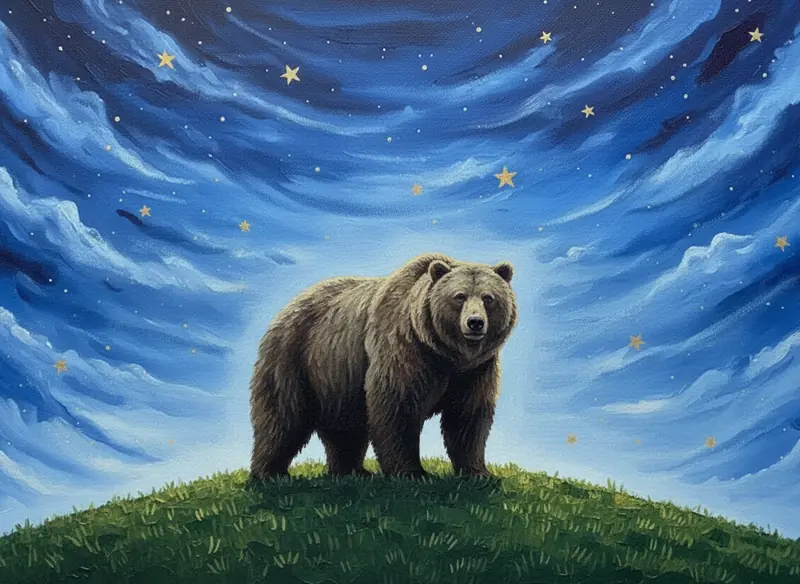
Key takeaways
- These dreams usually speak of raw strength, protective anger, solitude or a threat you are avoiding.
- An attacking animal and a sleeping one are different dreams; read the action first.
- Large, dangerous animals are frequent dream threats, likely because the brain rehearses danger while asleep.
- No research shows that dreaming of bears predicts danger, money or luck.
- Recurring nightmares of this kind respond well to treatment; they are not a sign that something is wrong with you.
Your dream
A reflection, not a prediction
You’ve had today’s free interpretation on this browser. Sign up with Apple or Google to keep it and get more.
Read the full interpretation — free
This is the first part of your interpretation. Create a free account to read the rest.
Sign up and this dream and its interpretation are saved to your journal. Otherwise they’re deleted in 24 hours. No card, no subscription.
On this page
What do bear dreams mean?
A bear in a dream is big, slow until it is not, mostly solitary and ferociously protective of its young. Nearly every reading of the bear dream meaning in dream interpretation, folklore and religion comes from one of those traits. Start with the one that matches how the dream felt.
Strength and anger
The animal stands for power that is usually calm and occasionally explosive. Dreaming of a bear often follows days when you swallowed anger or watched someone else lose theirs.
Protection and mothering
"Mama bear" is in the language for a reason. One guarding cubs can mirror your own protectiveness, or a parent, partner or boss who shields you and smothers you at once.
Solitude and retreat
Bears hibernate. A sleeping or wandering one can reflect a wish to withdraw, rest and come back later, or a part of you that already has.
A threat you avoid
An attacking, chasing or cornering animal borrows the oldest engine of dreams: something dangerous is close and you have not yet turned to face it.
These readings overlap. A grizzly charging through your kitchen is nothing like a cub sitting quietly under a tree, and the sections below sort the details that change the meaning.
Why bears appear in dreams
Large predators are far more frequent in dreams than in daily life, even in cities. Three findings from dream research explain why this one is among them.
Dreams rehearse threats
Antti Revonsuo's threat simulation theory holds that dreaming evolved partly to practise facing danger in safety. Animals and attacks make up a large share of the threats people report, and a grizzly is the biggest threat most of us can picture that still looks like something real. Nielsen's survey of typical dreams found being chased and attacked among the most universal themes.
Dreams continue your day
The continuity hypothesis, championed by dream researcher G. William Domhoff, says dreams draw on waking concerns and emotions. You rarely dream of one because you saw it; you dream of it because something that week felt large, powerful and unpredictable, a person, a deadline at work, a diagnosis, your own temper, and the sleeping brain picked a clear picture.
Emotion gets processed overnight
Matthew Walker's work on REM sleep suggests that dreaming takes some of the charge out of emotional memories. An animal that charges and then stops, or that you manage to calm, often marks that work in progress.
What to notice in your bear dream
Two people can dream of the same animal and need different readings. Before you look up a scenario, answer these:
- What was it doing? Sleeping, watching, following, charging, playing, eating, protecting cubs.
- Where were you? In the woods, at home, in a car, at work, in a cage or a zoo.
- What kind? Black, brown or grizzly, polar, panda, a teddy, one that talks.
- What did you do? Freeze, run, fight, hide, feed it, hug it, become it.
- How did you feel? Terror, awe, calm, tenderness, guilt.
- Who in your life is strong, protective and a little dangerous right now?
If the bear were a person or a situation in your life, who or what would it be?
Bear dream meanings by scenario
| Dream | What it tends to reflect |
|---|---|
| Bear attacking | A conflict that has arrived, with you or inside you |
| Bear chasing you | Something powerful you keep avoiding |
| Friendly bear | Strength that is on your side; a protector |
| Sleeping bear | A danger that is dormant, or your own need to rest |
| Bear cub | Something young and strong to protect; your own softer side |
| Bear with cubs | Protective love, often a mother's or your own |
| Hugging a bear | Making peace with your anger or with a difficult person |
| One in your house | Conflict or a dominant presence in the family |
| Killing it | Overcoming a fear or a powerful rival |
| Turning into a bear | Claiming your own strength, or fearing your temper |
| Teddy bear | Comfort, childhood, a need for reassurance |
Bear attacking, chasing or biting you
This is the version most people search for.
Chased by a bear
Being chased by this animal is a dream about avoidance. The animal is slow to start and then very fast, which is how an avoided problem behaves: ignorable for weeks, then suddenly on top of you. Ask what you have been outrunning, a conversation, a bill, a decision, a person's anger. In most dreams of being chased the pursuer is a stand-in for something you already know about.
Attacked or mauled
If the animal reached you, the conflict has arrived. Where it struck matters: the arms and hands point to work or to something you are holding on to, the back to a betrayal or something you did not see coming, the face to your reputation or how others see you. Being bitten is less about the wound than about the force behind it; compare it with a snake bite dream, which tends to feel sly rather than overwhelming.
Playing dead or fighting back
What you did is the most useful detail. Freezing suggests you feel powerless against the person or situation it stands for. Fighting back, especially winning, often appears when you are gathering the nerve to confront someone. Killing it in the dream can leave you guilty on waking; the guilt points to ambivalence about asserting yourself.
A friendly, calm or sleeping bear
Not every version is a nightmare, and the gentle versions are worth more attention than they get.
A friendly one that walks beside you, lets you touch it or simply watches without threat is a dream about strength that is on your side. It can be a protector in your life, a parent, a partner, a mentor, or your own power that you are finally comfortable with. People report these dreams during recovery or after setting a hard boundary.
A sleeping animal is more ambiguous. It can mean a danger that is dormant, an old conflict nobody wants to wake. It can also be a picture of your own exhaustion and a need to hibernate for a while. If you lay down beside it, you may be more at peace with your anger than you think.
Hugging it is a dream of reconciliation: with a difficult person, with your own temper, or with a part of yourself you have treated as dangerous.
Bear cubs, a mother bear and a bear with her young
Cubs shift the dream from fear toward care. A single cub often stands for something young and strong that needs protecting: a child, a new project, a tender part of yourself. If you were feeding or carrying it, you are the protector. If it was lost or hurt, ask what vulnerable thing in your life is not getting enough shelter.
A mother with cubs is the dream's clearest image of protective love, and it can cut both ways. Dreamt by a parent, it usually reflects their own fierce protectiveness. Dreamt about a parent, it can show a mother or father whose care felt like a wall. Carl Jung read the animal as one face of the mother archetype: nourishing and devouring at once. People hoping for a baby or navigating a pregnancy often meet her in their sleep.
If she charged you because you were near her cubs, the dream is asking whose territory you have stepped into, or who in your family feels threatened by you lately.
Bear in your house, bedroom or garden
The setting tells you where in your life the strength or the threat sits.
Finding one in your house brings the theme home: a dominant presence in the family, a conflict in the household, or your own anger surfacing where you usually hide it. Note the room. The kitchen points to how you are nourished and what you provide, close to what food means in dreams; the bedroom points to intimacy and to a partner who feels overwhelming or protective. One at the door that you keep out is a boundary holding; one that walks in as if it lives there often reflects someone whose presence you have stopped questioning.
In the garden or just outside the window, the animal is danger kept at a distance you can still see. At work or at school, the animal usually wears the face of a boss, a teacher or a rival whose power feels outsized; people you fear often arrive in dreams as animals. In water it combines strength with emotion: a powerful feeling moving under the surface, close to drowning dreams, or a person who is intense and hard to read.
Bear colours: black, brown, grizzly, polar and panda
Colour and species are modifiers. Read the action first, then let the species sharpen it.
| Bear | What it tends to add |
|---|---|
| Black bear | Something hidden or unconscious; a threat that is more startling than lethal |
| Brown bear | Earthy, practical strength; ordinary anger; a grounded protector |
| Grizzly bear | Raw, uncontrolled force; the most frightening version of the dream |
| Polar bear | Isolation, emotional cold, a threat in a place that should be empty |
| White bear | Clarity or a purity that hides power; sometimes grief |
| Panda bear | Gentleness, a strong thing that seems harmless, a need for comfort |
| Red or golden bear | Passion or anger close to the surface, like fire in dreams |
Black bears are the ones most Americans actually see, which is why that version often feels realistic and personal. Polar bears appear in dreams of people who feel alone in a cold environment, a new city, a distant marriage, a workplace without warmth. A panda is almost always a comfort dream, close in spirit to a teddy or to the slow calm of a turtle; even the gentle animals in animal dreams still carry a hint of the power behind them.
Teddy bears and cartoon bears
A teddy is a different symbol from a wild animal, and it deserves its own line. It stands for comfort, childhood and the need for reassurance. Adults dream of their old teddy during stress, grief and big transitions. A torn or lost teddy often marks the end of an innocence or a safety you took for granted. A cartoon or talking one tends to be the dreamer's own thoughts in costume; listen to what it said.
Biblical meaning of a bear in a dream
The Bible mentions the animal more often than most people expect, and almost always as a picture of fierce, sudden power.
- A bear robbed of her cubs is the proverb's image of rage (Proverbs 17:12; 2 Samuel 17:8; Hosea 13:8).
- David tells Saul he killed both a lion and a bear while guarding sheep (1 Samuel 17:34-36), a story of courage against overwhelming odds.
- Two she-bears maul the youths who mocked Elisha (2 Kings 2:24), a hard text about judgement.
- In Daniel 7:5 the second beast of the vision is like a bear, standing for a devouring empire.
- Isaiah 11:7 pictures the bear grazing with the cow in a healed world.
None of these are dream symbols, so a biblical meaning of a bear in a dream is built from these themes rather than from a verse: wrath, protective fury, a test of courage, a power that must be faced, and, in Isaiah, fierce strength made peaceful. Christian writers who interpret dreams tend to read a threatening one as a spiritual attack or a warning about anger, and a tamed one as God subduing a danger. Treat those as a devotional lens, not a prediction.
Spiritual meaning of bears across cultures
It is one of the oldest animals in human religion, and much of the spiritual meaning people give the dream comes from these traditions.
- Indigenous North America. For many nations it is a healer and a figure of strength and introspection; bear medicine is linked with going inward, as the animal does in winter.
- Northern Europe. Norse berserkers took its name and spirit into battle. Finnish and Sami traditions treated the animal as a sacred ancestor whose true name was not spoken.
- Greece. Artemis, goddess of the wild and of childbirth, was linked with the animal; Callisto was turned into one and set among the stars as Ursa Major.
- Korea. In the founding myth, a bear becomes the woman Ungnyeo, mother of the first king: patience rewarded with transformation.
Across these, the shared meanings are strength, healing, protection, going inward and coming back changed. None of them claim the dream brings those things; they claim the image means them.
Is dreaming of a bear good or bad?
Mostly neither. Dream researchers sort dreams by emotion and content, not by omen, and the feeling you woke with is the best guide.
Terror or dread: the dream has borrowed the threat engine, the same one behind lion, tiger and alligator dreams, and the question is which powerful thing you are avoiding. Awe: you are looking at strength, yours or someone else's. Tenderness: the protective reading fits, and the creature is on your side. Guilt, especially after killing or caging the animal, points to mixed feelings about your own assertiveness.
Folk belief in some places calls the dream a sign of a powerful enemy or, if the animal is calm, of a strong friend. It is not a death omen in any serious tradition.
Write the scene down before it fades: the kind of animal, what it did, where you were, who was with you, whether a partner, a dog or a stranger, and the feeling. If the dream recurs with distress, imagery rehearsal, where you rewrite the ending while awake and replay it, has good evidence for recurring nightmares; facing or befriending the creature in the rewritten version is a common choice.
Questions people ask
What does it mean to dream about bears?
Dreams about bears usually reflect a force you respect and cannot fully control: your own held-back anger, a powerful or protective person, or a danger you have been avoiding. A calm one mirrors strength and solitude; an attacking one marks a conflict that has arrived. Read what the animal did and how you felt before you look at its colour or size.
What does it mean when a bear chases you in a dream?
A chase is a dream about avoidance. Something powerful is behind you and you have not turned to face it: a hard conversation, a debt, a decision, someone's temper. Its pattern of slow then fast mirrors how avoided problems behave. Ask what you have been outrunning this month; the answer is usually quick to come.
What does a bear attacking me in a dream mean?
An attack means the conflict has reached you. Where it struck gives a clue: hands and arms point to work or to something you are gripping, the back to something you did not see coming, the face to how others see you. The dream is about the size of the force, not a literal injury. If you fought back, you are gathering the nerve to confront someone.
Is dreaming of a bear a good sign?
Neither good nor bad on its own. A friendly or calm one usually reflects strength on your side and is a reassuring dream; a threatening one marks something you are avoiding and is useful rather than ominous. Folk traditions call the animal a sign of a strong enemy or a strong friend, but no evidence shows that dreams predict events.
What is the biblical meaning of a bear in a dream?
The Bible uses the bear as a picture of fierce, sudden power: a she-bear robbed of her cubs (Proverbs 17:12), David's fight with a bear (1 Samuel 17), the bear-like beast of Daniel 7, and the bear grazing peacefully in Isaiah 11. It is never a dream symbol in Scripture, so a biblical reading points to anger, courage and a power to be faced, not to a specific prophecy.
What does a friendly bear in a dream mean?
It reflects strength that is on your side. It can be a protector in your life, a parent, partner or mentor, or your own power that you have grown comfortable with. People report this dream after setting a boundary, during recovery, or when they start standing up for themselves. Hugging it adds a note of reconciliation with a difficult person or with your own temper.
What do bear cubs in a dream mean?
Cubs turn the dream toward care. A single cub stands for something young and strong that needs protecting: a child, a project, a tender side of yourself. A mother with cubs is protective love at full strength, which can feel like warmth or like a wall depending on who she is. If she charged you, ask whose territory you have stepped into.
What does a black bear in a dream mean?
It adds the theme of something hidden or unconscious and is often the most realistic bear dream, since that species is the one most North Americans actually encounter. It tends to be startling rather than lethal, a threat that surprises you more than it harms you. Read the action first: a calm one and a charging one are different dreams.
Why do I keep dreaming about bears?
Recurring dreams track unresolved waking themes. If the animal keeps returning, something in your life stays powerful and unaddressed: a person, a conflict, your own anger. Write down each version and compare its behaviour and your response; the detail that changes is usually the one that matters. If the dreams are distressing, imagery rehearsal therapy has strong evidence for recurring nightmares.
The bottom line
The bear dream meaning comes down to power and how you stand in relation to it. An attacking or chasing one shows a conflict or a powerful person you have been avoiding; a calm, friendly or sleeping one reflects strength on your side, a need to withdraw, or anger that has settled. Cubs and a mother with her young bring in protective love, with its warmth and its walls. Scripture and world traditions read the animal as fury, courage, healing and transformation, and none of them promise events. Note the species, the action, the place and your feeling, and the dream usually points at one large, unpredictable thing in your waking life.

Clinical psychologist in private practice in Minnesota who works with adults on anxiety, stress and sleep problems, including recurring nightmares.
Sources
- Revonsuo, A. (2000). The reinterpretation of dreams: An evolutionary hypothesis of the function of dreaming. Behavioral and Brain Sciences.
- Nielsen, T. A., et al. (2003). The Typical Dreams of Canadian University Students. Dreaming.
- Domhoff, G. W. (2003). The Scientific Study of Dreams. American Psychological Association.
- Krakow, B., & Zadra, A. (2006). Clinical Management of Chronic Nightmares: Imagery Rehearsal Therapy. Behavioral Sleep Medicine.
- Jung, C. G. (1964). Man and His Symbols.