

Key takeaways
- Dinosaurs in dreams usually stand for something old that still feels overwhelming.
- Being chased by a dinosaur mirrors running from an issue you have not faced.
- A calm or friendly dinosaur reflects the past losing its threat.
- For children, dinosaur nightmares are a normal form of fear of big, powerful things.
- The dream does not predict disaster; it reflects what already weighs on you.
Your dream
A reflection, not a prediction
You’ve had today’s free interpretation on this browser. Sign up with Apple or Google to keep it and get more.
Read the full interpretation — free
This is the first part of your interpretation. Create a free account to read the rest.
Sign up and this dream and its interpretation are saved to your journal. Otherwise they’re deleted in 24 hours. No card, no subscription.
On this page
What do dinosaurs mean in a dream?
A dinosaur is the perfect dream image for the past. It is enormous, it is extinct, and it is still everywhere: in museums, films and children's bedrooms. When one shows up in your dream, ask what in your life is old, outsized and supposedly over. A family pattern you swore you would never repeat. A fear from childhood. A way of working or relating that no longer fits but refuses to die.
Psychologists who study dream content find that what you dream about tracks what occupies you awake, including the things you avoid. A dinosaur rarely means you watched a film the night before, though that happens. More often it is the mind's shorthand for "this is big, it is from a long time ago, and it still has teeth."
What part of your past still feels bigger than you, even though it should be extinct by now?
Before you interpret: what to notice
- Which dinosaur. A T-Rex, a raptor, a long-necked plant eater, a flying reptile.
- What it did. Chased you, attacked, ignored you, walked past, died.
- Where you were. A city, your house, a jungle, a museum.
- How you felt. Terror, awe, calm, curiosity, sadness.
Being chased by a dinosaur
This is the most common dinosaur dream, and it works like every other being chased dream: the thing behind you is something you are avoiding. The dinosaur adds two details. It is old, so the issue has roots in your past. And it is huge, so you believe you cannot fight it, only run. A debt, a confrontation with a parent, a health check you keep postponing, a grief you have not sat with. If you hid, ask what you are hiding from. If you turned and faced it, the dream is showing you ready for that conversation.
A dinosaur attack
A dinosaur that attacks, bites or tramples you brings the fear into contact. Attack dreams often follow a day when someone powerful, a boss, a parent, an institution, pushed you around and you could not push back. The size gap between you and the animal mirrors the power gap you feel. Compare it with attack dreams in general; the dinosaur version says the aggressor feels ancient and unstoppable, which is usually how old authority figures feel.
A T-Rex, a raptor or a gentle giant
| Dinosaur | Common reading |
|---|---|
| T-Rex | Raw power and anger, often an authority figure or your own rage |
| Raptors (fast, in a pack) | Many small worries that hunt together; anxiety that feels clever |
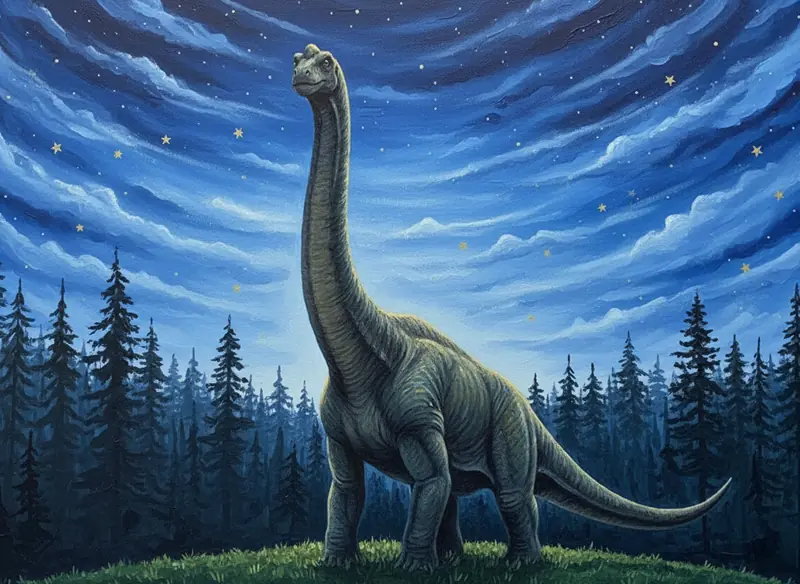
| Long-necked plant eater | The past as something calm and even comforting |
| Flying reptile (a pterosaur, not strictly a dinosaur) | A fear that comes from above: judgment, deadlines, "fate" |
| Dinosaur eggs or babies | Something old starting again, or a family pattern passed to a child |
Pick the row that matches your dream, then check it against how you felt. A gentle T-Rex is possible, and then the calm matters more than the species.
Calm, friendly or dying dinosaurs
Not every dinosaur dream is a nightmare. Watching dinosaurs graze, riding one or feeding one often reflects a past you have made peace with. The thing that used to terrify you is now something you can look at. A dying or dead dinosaur usually marks the end of an old habit, belief or relationship that ran your life for years. Some people feel sad in these dreams; that sadness is normal when something big, even something harmful, is finally gone.
Dinosaurs in the city or in your house
Dinosaurs walking through a modern city mix two time periods, which is what the dream is about: the past intruding on the present. An old problem has shown up in your current life, often because someone from your past has reappeared. A dinosaur in your house makes it personal and domestic: a family issue, a childhood dynamic, a parent's voice in your head. If the house was your childhood home, the link to the past is almost explicit.
Dinosaur dreams in children
Scary dreams are common between about four and twelve, animals appear more often in children's dreams than in adults', and dinosaurs are often the biggest, most real monster a child knows. A child's dinosaur nightmare is a normal way of handling fear of large, powerful things, including adults and the world beyond home. It helps to listen, to ask what the dinosaur wanted, and to let the child draw or retell the dream with a different ending. Frequent nightmares that disturb sleep for weeks are worth mentioning to a pediatrician.
Dinosaurs, dragons and spiritual readings
Dinosaurs share dream space with dragon, giant and crocodile images. The dragon leans toward myth and a guarded treasure; the giant toward a person who overshadows you; the crocodile toward a hidden danger in your emotional life. The dinosaur is specific about time: its message is "this belongs to the past," and what feels unstoppable may already be extinct in every way but your memory of it.
Dinosaurs are too recent a discovery to appear in old dream books, so most spiritual readings borrow from the serpent and the dragon: primal power, something ancient waking up. Some readers treat a dinosaur as a call to shed outdated beliefs the way a reptile sheds skin. Treat these as ways of thinking about the dream, not as forecasts. Nothing in a dinosaur dream predicts a disaster.
Questions people ask
What does it mean when you dream about dinosaurs?
It usually reflects something from your past that still feels huge: an old fear, a family pattern or a problem you thought was over.
What does it mean to be chased by a dinosaur in a dream?
You are avoiding an issue with roots in your past that feels too big to fight. The dream shows the running, and sometimes the readiness to turn around.
What does a T-Rex in a dream mean?
Raw power and anger, often linked to an authority figure or to your own suppressed rage.
Why do children have dinosaur nightmares?
Animals appear more often in children's dreams than in adults', and dinosaurs are often the biggest monster a child knows. These nightmares are a normal way of processing fear of large, powerful things.
Is a dinosaur dream a bad sign?
No. Dreams do not predict disasters. A dinosaur dream reflects old fears and patterns that already affect you.
The bottom line
A dinosaur dream usually points to something old that still feels enormous: a fear, a family pattern, an outdated way of living. Being chased reflects avoidance; an attack, a power gap with someone who feels ancient and unstoppable; a calm or dying dinosaur, a past you have made peace with. For children, dinosaur nightmares are a normal part of growing up. Note which dinosaur it was, what it did and how you felt, then ask what from your past has reappeared. The dream predicts nothing. It shows what already weighs on you.

Clinical psychologist in private practice in Minnesota who works with adults on anxiety, stress and sleep problems, including recurring nightmares.
Sources
- Muris, P., Merckelbach, H., Gadet, B., & Moulaert, V. (2000). Fears, worries, and scary dreams in 4- to 12-year-old children. Journal of Clinical Child Psychology, 29(1).
- Schredl, M., & Hofmann, F. (2003). Continuity between waking activities and dream activities. Consciousness and Cognition, 12(2).
- Revonsuo, A. (2000). The reinterpretation of dreams: An evolutionary hypothesis of the function of dreaming. Behavioral and Brain Sciences, 23(6).
- Domhoff, G. W. (2003). The Scientific Study of Dreams. American Psychological Association.