

Key takeaways
- Crocodile dreams most often reflect a hidden threat, a two-faced person, or instinct you keep below the surface.
- An attacking crocodile and a calm one carry different meanings; the action matters more than the animal.
- Water settings point to emotion, house settings to family or private life.
- Ancient traditions read the crocodile as both devourer and protector.
- No dream predicts money, pregnancy or disaster; recurring crocodile nightmares are treatable.
Your dream
A reflection, not a prediction
You’ve had today’s free interpretation on this browser. Sign up with Apple or Google to keep it and get more.
Read the full interpretation — free
This is the first part of your interpretation. Create a free account to read the rest.
Sign up and this dream and its interpretation are saved to your journal. Otherwise they’re deleted in 24 hours. No card, no subscription.
On this page
What does a crocodile dream mean?
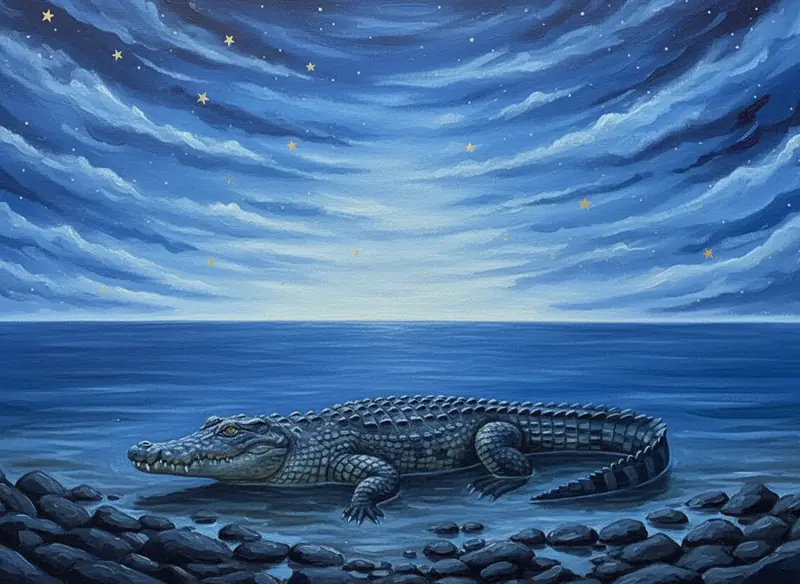
A crocodile lies still for hours, mostly underwater, and then moves faster than anyone expects. That single fact explains most of the crocodile dream meaning you will find in psychology, folklore and religion. Four readings cover the majority of dreams.
A threat under the surface
Something is wrong and you half know it: a problem at work, a health worry, a debt. The reptile waits where you cannot quite see it. Frightening crocodile dreams usually belong here.
Someone two-faced
"Crocodile tears" is an old phrase for fake sorrow. Dreaming of a crocodile often follows contact with a person who smiles and bites, or a growing sense that you are being deceived.
Instinct held down
Anger, hunger, desire, ambition: the cold, patient drives you keep submerged. The animal surfaces when they want room.
Patience and survival
Crocodiles have barely changed in millions of years. In calmer dreams the creature can stand for endurance, thick skin and the ability to wait.
These readings overlap. A crocodile in your kitchen combines threat and closeness; one drifting past in a river feels like something else entirely. The sections below take the details one at a time.
Why crocodiles appear in dreams
Most people who dream about crocodiles have never met one. Dream researchers offer three reasons the animal still turns up.
The first is threat simulation. Antti Revonsuo argued that dreaming evolved to let us rehearse danger in safety, and a large ambush predator is close to the oldest danger our species knows. The second is continuity: G. William Domhoff's work shows that dreams carry forward the concerns of waking life, so a looming problem can take the shape of a lurking reptile. The third is culture. Documentaries, zoo visits, news stories and films supply the imagery, and a brain searching for a picture of hidden menace reaches for it.
Animals appear regularly in dreams, especially in children's dreams, and many of them are wild or threatening. Crocodiles are probably less common dream animals than snakes or dogs, which is partly why a crocodile dream feels so memorable.
What to notice before you interpret
Two people can both dream of a crocodile and need different readings. Before you look up a scenario, answer these questions:
- What was the crocodile doing? Attacking, watching, swimming away, basking, following you?
- Where was it? In a river, a swimming pool, your house, the street, a cage?
- How did you react? Ran, fought, froze, felt curious, felt nothing?
- Who else was there? A partner, a child, a colleague?
- What in your life right now feels calm on top and dangerous underneath?
If the crocodile were a person or a situation you know, who or what would it be?
Crocodile dream scenarios at a glance
| Dream | What it often reflects |
|---|---|
| Crocodile attack | A conflict or betrayal that has already surfaced |
| Crocodile chasing you | A problem you keep avoiding that is gaining on you |
| Being bitten or attacked | Harm from someone or something you trusted to stay still |
| Calm crocodile, no attack | A danger you are aware of and managing |
| Killing a crocodile | Facing a fear, cutting off a harmful tie |
| Dead crocodile | A threat that has passed or lost its power |
| Giant crocodile | A problem that feels larger than you |
| Many crocodiles | Several pressures at once, a hostile environment |
| Baby crocodile | A small problem that could grow, or a new instinct |
| Crocodile in the house | Tension in the family or private life |
| Crocodile in clear water | Emotions you can see and name |
| Hugging a crocodile | Making peace with a part of yourself, or trusting someone risky |
Crocodile attacking or chasing you
An attack is the most common crocodile dream and the most frightening. The reptile lunges from water, grabs a leg, pulls you under. In waking terms, something that was lying still has moved: an argument finally broke out, a colleague showed their hand, a debt came due.
Being chased by a crocodile is slightly different. The danger has not landed yet, and you are spending energy running from it. Ask what you are putting off. Many people have this dream in the weeks before a confrontation they know is coming.
If the crocodile attacked someone else, a child or a partner, the dream usually reflects protective fear. If it attacked and you felt no pain, the mind may be testing a danger rather than suffering it. A snapping jaw that never quite closes is a very common version, and it mirrors anxiety more than harm. A dream of a snake bite carries a similar message with a smaller, quicker animal.
A calm crocodile that does not attack
Not every crocodile in a dream is hostile. Many people describe one lying on a bank, drifting in a river, or even sitting in the garden while life goes on around it. These dreams tend to be unsettling rather than terrifying.
The usual reading is awareness. You know where the danger is. You can see the person who might hurt you or the problem that might grow, and for now it is still. Some dreamers read the calm crocodile as their own patience: the ability to wait, watch and strike only when needed. If the animal looked at you and you looked back without fear, the dream may be about respect for your own strength rather than any outside threat.
Killing a crocodile, or finding one dead
Fighting and killing a crocodile in a dream is exhausting and often ends in waking with a racing heart. Psychologically it is a victory dream: you confronted something that frightened you and you prevailed. People report it after leaving a toxic relationship, winning a dispute or finally speaking up.
A crocodile that is already dead carries a quieter message. The threat has passed, or a fear turned out to be smaller than it looked. If you felt sad about the dead animal, the dream may be about a part of your own strength or instinct that you have shut down. Blood in the scene adds intensity: the cost of the fight was real.
Where the crocodile is: water, house, land
Setting changes the meaning more than almost anything else.
In water
A crocodile in a river, lake or sea is in its element, and so is the emotion it represents. Water in dreams tends to stand for feelings, and the animal beneath it is a feeling you have not yet brought to the surface. Clear water means you can see the danger coming; murky water means you cannot. If the water rose around you like a flood or you were drowning while the crocodile approached, the dream speaks of being overwhelmed as much as threatened.
In your house
A crocodile in your house, especially in the bedroom or kitchen, puts the threat inside your private life. It can point to tension in the family, a partner you doubt, or a secret you are keeping at home. A crocodile in a child's room usually reflects protective anxiety, not danger to the child.
On land, in the street, in a cage
On dry ground the crocodile is slower and more visible. The danger has left its hiding place. In a zoo or cage, the threat is contained, and the dream may be about something you have under control but do not quite trust to stay that way.
Giant crocodiles, many crocodiles, baby crocodiles
Size and number scale the feeling.
A giant crocodile, far bigger than any real one, mirrors a problem that feels larger than you: an illness in the family, a legal case, a financial hole. The exaggeration is the mind's way of showing how heavy it feels, not how dangerous it is.
Many crocodiles, a river full of them or a floor crawling with them, usually reflect an environment that feels hostile on every side, such as a workplace where you trust no one, or a period when several people in your life seem to be waiting for you to slip.
A baby crocodile looks harmless and is not. It often stands for a small problem you are tempted to ignore, or for a new instinct, a new ambition, that is still young. Dreams of a baby and a baby crocodile sometimes appear together during big life changes.
Crocodile colours and what they add
Colour in a crocodile dream is usually less important than the action, but it can add a shade of meaning.
| Colour | Common reading |
|---|---|
| Green or grey (natural) | A real-world concern, something ordinary turned threatening |
| Black | A fear you have not named, the unknown |
| White | A threat disguised as something pure, or a truth coming to light |
| Blue | Emotion and intuition; a danger you sense rather than see |
| Red | Anger, passion, urgency |
| Yellow | Caution, jealousy, a warning you have been given |
| Golden | Power and resources; a threat to or from money |
Unnatural colours usually signal that the dream is more about your inner state than about any external person.
Alligator or crocodile: does it matter?
Most dreamers cannot tell the two apart, and the dreaming mind does not care about taxonomy. Both are large, patient, ambush reptiles, and in dream interpretation they carry the same core meaning. If you want the distinction, the page on alligator or crocodile goes through it, and dreams of an alligator have their own entry. In the United States, "alligator" is often the word people reach for; in Africa, Asia and Australia it is almost always crocodile. The word you use says more about where you live than about the dream.
Spiritual meaning of a crocodile dream
Across cultures the crocodile is one of the oldest sacred animals, and it is nearly always double: destroyer and protector at once.
In ancient Egypt, the god Sobek had a crocodile's head and ruled the Nile's fertility and the army's strength. Egyptians feared the animal and mummified it in temples. A crocodile in a dream, read through this lens, is raw power that can protect or devour depending on how it is treated.
In Hindu tradition, the makara, a crocodile-like sea creature, carries the river goddess Ganga and the god Varuna, and guards temple entrances. Among Aboriginal Australian peoples, the saltwater crocodile appears in creation stories as an ancestor and lawgiver. In West African traditions, crocodiles are sometimes kept in sacred pools as spirits of the ancestors.
Modern spiritual readings pull these threads together: a crocodile dream asks you to respect your own power, to be patient, and to look at what you are hiding beneath the surface. Some see it as a call to protect your boundaries from a person trying to take what is yours. These are frameworks for reflection, not forecasts.
Biblical meaning of crocodiles in dreams
The Bible does not use the word crocodile, but two passages are often read as describing one. Leviathan in Job 41, with its armoured back, terrible teeth and scorn for weapons, is understood by many scholars as a Nile crocodile raised to mythic scale. In Ezekiel 29, Pharaoh is called "the great monster lying in the midst of his rivers", a crocodile image for a proud ruler who will be dragged from the water.
Christian readers therefore tend to take a crocodile in a dream as pride, a powerful enemy, or a hidden danger that only God can tame. Some read it as a warning about deception, drawing on the crocodile's stillness before it strikes. In Islamic dream interpretation, a crocodile is traditionally read as a treacherous or unjust person, or as an authority to be wary of. In all these traditions the dream is a prompt to examine your situation, not a prediction of harm or death.
What psychology says about crocodile dreams
The scientific picture is modest and useful. Dreams draw heavily on memory, as Malinowski and Horton showed when they traced dream images back to waking experiences, so a crocodile often arrives after you have seen one on a screen or thought about a predator in any form. Threat dreams cluster in stressful periods, and their content follows what is worrying you.
In Jungian terms the crocodile is a shadow animal: cold, ancient, instinctive, the part of the psyche that civilised life keeps underwater. Dreaming of it can mean that anger or desire you have disowned is asking to be acknowledged. Sigmund Freud wrote that wild animals in dreams usually stand for passionate impulses, whether the dreamer's own or someone else's.
If crocodile nightmares repeat and disturb your sleep, imagery rehearsal therapy, described by Krakow and Zadra, teaches you to rewrite the dream while awake. It is a well-studied treatment for recurring nightmares, including attack dreams.
Is a crocodile dream good or bad?
It is neither. The dream is information about what you fear, suspect or hold back. People often ask whether crocodile dreams mean money is coming, a pregnancy is near, or an enemy is about to strike. No research supports any of that. Folk traditions in several countries do call the crocodile a sign of wealth or protection, and you are welcome to take comfort from them, but a dream does not change what tomorrow holds.
What the dream can do is point you toward a conversation you are avoiding, a decision about your job, or a person whose smile you do not trust. That is its practical value. Similar lessons come from other predator dreams: a lion speaks of open power, a tiger of sudden force, a bear of a threat that can also protect. The crocodile is the one that hides.
What to do after a crocodile dream
- Write it down the same morning: action, setting, your reaction, who else was there.
- Name the thing in your life that is still on the surface and dangerous underneath. There usually is one.
- If someone came to mind as the crocodile, notice that without acting on it. Dreams flag suspicion; they do not prove it.
- Check whether you have been swallowing anger. The crocodile often carries what you will not say.
- Look at nearby creatures in your dream for context: fish and turtles usually soften the scene, a frog adds a note of change.
- If the dream repeats weekly or wakes you in fear, speak to a therapist. Recurring nightmares often respond well to treatment.
Questions people ask
What does it mean to dream of a crocodile?
A crocodile in a dream usually stands for a hidden danger, a two-faced person, or an instinct such as anger that you keep below the surface. In calmer dreams it can represent patience and survival. The action, the setting and how you felt tell you which reading applies.
What does a crocodile attacking me in a dream mean?
An attack means something that was lying still has moved: a conflict broke out, a betrayal came to light, a problem you ignored caught up with you. It is one of the most common crocodile dreams and reflects stress, not a prediction of harm.
What does it mean when a crocodile does not attack in a dream?
A calm crocodile usually means you are aware of a danger and watching it. You can see the person or problem that might hurt you, and for now it is still. Some dreamers read it as their own patience and self-control.
Is dreaming of a crocodile good or bad?
Neither. The dream shows what you fear, suspect or hold back, which is useful information. Folk traditions sometimes call it a sign of wealth or protection, but no research shows dreams predict events. Its value is in what it prompts you to look at.
What is the spiritual meaning of a crocodile in a dream?
Spiritually the crocodile is double: destroyer and protector. Ancient Egypt worshipped it as Sobek, Hindu tradition carries the river goddess on a crocodile-like makara, and Aboriginal Australian stories make it an ancestor. Modern readings ask you to respect your power and look at what you hide.
What does a crocodile mean in the Bible?
The Bible does not name crocodiles, but Leviathan in Job 41 and the "great monster" of the Nile in Ezekiel 29 are often read as crocodile images. In Christian interpretation a crocodile dream points to pride, a powerful enemy or hidden danger, and a call to rely on faith rather than fear.
What does a giant crocodile in a dream mean?
A giant crocodile mirrors a problem that feels larger than you, such as an illness in the family, a legal case or a financial hole. The exaggerated size shows how heavy the worry feels. It does not measure real danger.
Why do I keep dreaming about crocodiles?
Recurring crocodile dreams usually track a worry that has not been resolved: a person you distrust, a conflict you avoid, anger you swallow. Writing the dreams down often reveals the pattern. If they wake you in fear more than once a week, imagery rehearsal therapy with a therapist helps.
What is the difference between an alligator and a crocodile dream?
In dream interpretation there is none. Both are large ambush reptiles and carry the same core meaning of hidden threat and raw instinct. The word you use usually reflects where you live. The pages on alligator dreams and on alligator versus crocodile go into the details.
The bottom line
A crocodile dream is about what waits under the surface: a problem you half see, a person who is not what they seem, or your own cold, patient instinct. An attack says the danger has moved; a calm crocodile says you can see it and are watching; killing it says you have faced it. Water points to emotion, the house to private life, size to how heavy the problem feels. The animal has been both devourer and protector in human stories for thousands of years, and it plays both roles in dreams. Take the dream as a prompt to look harder, not as a forecast.

Clinical psychologist in private practice in Minnesota who works with adults on anxiety, stress and sleep problems, including recurring nightmares.
Sources
- Revonsuo, A. (2000). The reinterpretation of dreams: An evolutionary hypothesis of the function of dreaming. Behavioral and Brain Sciences.
- Domhoff, G. W. (2003). The Scientific Study of Dreams. American Psychological Association.
- Malinowski, J., & Horton, C. L. (2014). Memory sources of dreams. Journal of Sleep Research.
- Krakow, B., & Zadra, A. (2006). Clinical Management of Chronic Nightmares: Imagery Rehearsal Therapy. Behavioral Sleep Medicine.
- Jung, C. G. (1964). Man and His Symbols.
- Freud, S. (1900). The Interpretation of Dreams.