

Key takeaways
- Crabs in dreams usually point to protection: shells, boundaries and self-defense.
- A pinch or bite often mirrors a sharp word or a small hurt from someone close.
- Moving sideways can reflect avoiding a direct conversation or decision.
- Hermit crabs and molting crabs speak to change and feeling exposed.
Your dream
A reflection, not a prediction
You’ve had today’s free interpretation on this browser. Sign up with Apple or Google to keep it and get more.
Read the full interpretation — free
This is the first part of your interpretation. Create a free account to read the rest.
Sign up and this dream and its interpretation are saved to your journal. Otherwise they’re deleted in 24 hours. No card, no subscription.
On this page
What does it mean to dream about a crab?
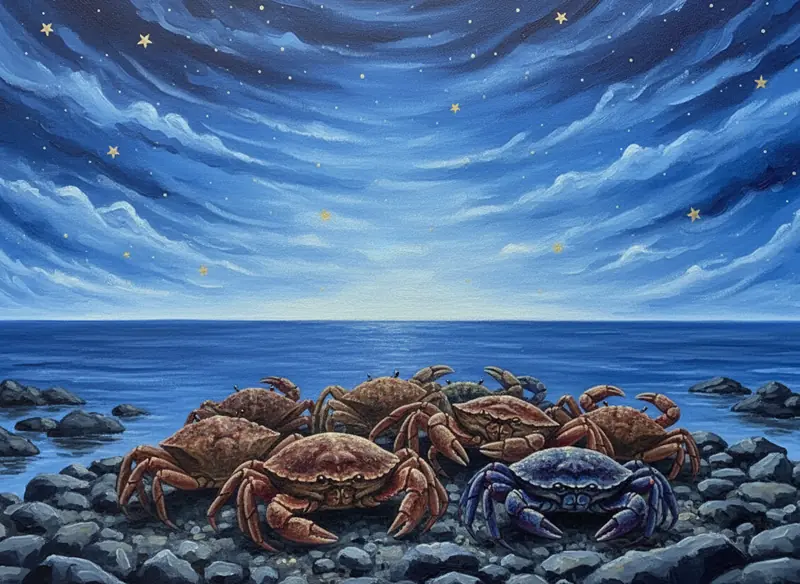
A crab is a soft animal inside hard armor. It watches from the edge of the water, scuttles sideways when approached, and uses its claws only when it feels cornered. Those habits shape most crab dreams.
Dreaming of a crab often reflects how you protect yourself. You may be keeping people at a distance, holding back feelings, or feeling that someone else has shut you out. The crab can also mirror irritability: English speakers call a grumpy person "crabby" for a reason.
Where in your life are you guarding something soft behind a hard shell?
Before you interpret: what to notice
- What the crab did. Watched, ran, pinched, followed you, was cooked on a plate.
- Where it was. On the beach, in the sea, inside your house, in your bed.
- How many. One crab, or dozens covering the ground.
- How you felt. Curious, disgusted, scared, amused.
Crab pinching or biting you
This is the most common crab scene. A pinch is small, sudden and sharp, and the dream often mirrors exactly that kind of hurt: a sarcastic remark, a partner's sharp tone, a colleague's criticism. Notice where it pinched. A crab on your hand or finger can point to something you are doing or reaching for; one on your foot, to the path you are taking.
If you were the one grabbing at the crab, the dream may be asking whether you pushed into a situation that was already defensive.
Crabs on the beach or in the sea
Crabs at the shoreline live between land and water, between what you show and what you feel. Watching them calmly on the sand can reflect an easy relationship with your emotions. Crabs swarming at your feet when the tide comes in can mirror small worries piling up. If the ocean was rough, the emotional backdrop of the dream matters as much as the crabs.
Crabs in the house or in bed
A crab indoors usually points to tension close to home: irritability in the family, guardedness between partners, or a home that feels less safe than it should. A crab in your bed adds intimacy to the picture, often a sign that closeness and defensiveness are mixed right now.
Hermit crabs, molting and empty shells
| Scene | Common reading |
|---|---|
| A hermit crab changing shells | Outgrowing a role, home or relationship and looking for a better fit |
| A crab shedding its shell | A vulnerable phase while you grow; you may feel exposed |
| An empty crab shell | Something you have left behind, or a defense you no longer need |
| A soft-shelled crab | Being open before you feel ready |
Hermit crabs are a strong image of change. Biologists have shown that they weigh the value of their shell against discomfort and will leave a poor shell under pressure, which fits the way these dreams often appear when people are deciding whether to stay or move on.
Crabs walking sideways
A crab rarely walks straight toward anything. Dreaming of a crab scuttling sideways can reflect avoidance: circling a hard conversation, delaying a decision, or taking the long way around a problem. It is not a judgment. Sometimes the sideways route is wise. Ask whether your detour is protecting you or keeping you stuck.
Many crabs or crabs in a bucket
Lots of crabs at once often mirrors a crowded, competitive feeling. The phrase "crabs in a bucket" describes people pulling each other down instead of climbing out. If your dream had that feel, think about a group, team or family where success feels hard to share.
Eating crab or a dead crab
Eating crab in a dream often relates to enjoyment and effort together: you have to crack the shell to reach the meat. It can reflect a reward that takes work, or a food memory from a trip or celebration. A dead crab can point to a defense that has lost its purpose, or simply to something from the day, like seafood you saw at a market.
Spiritual and cultural meanings
The crab gives its name to Cancer, the zodiac sign of home and protection. In Greek myth, a crab sent by Hera pinched Heracles during his fight with the Hydra and was set among the stars. Many coastal cultures link crabs to the moon and the tide. These are traditions and stories, not forecasts. A crab dream does not mean illness, money or bad luck is coming.
Questions people ask
What does it mean when a crab bites you in a dream?
It often mirrors a small, sharp hurt, such as a cutting remark or criticism. Notice who was nearby in the dream and where the crab pinched.
Is dreaming about crabs good or bad?
Neither by itself. Calm crabs can point to healthy boundaries, while aggressive ones reflect tension or defensiveness. Your feelings in the dream decide the reading.
What does a hermit crab mean in a dream?
Usually change: outgrowing a role, home or relationship and looking for a better fit. It can also reflect feeling exposed between one "shell" and the next.
What does it mean to dream of crabs in your house?
It often points to tension or guardedness close to home, in your family or with a partner.
Does a crab dream have anything to do with cancer the illness?
No. The illness and the zodiac sign share a name because both come from the Greek and Latin words for crab; ancient physicians compared the shape of some tumours to a crab. A crab dream does not predict any illness.
The bottom line
A crab dream usually reflects protection: a shell you keep up, a pinch you felt, or a sideways route around something hard. Notice whether the crab was calm or defensive, where it was and how you reacted. A peaceful crab can point to healthy boundaries; a biting one, to a sharp moment with someone close. Hermit crabs and molting add the theme of growth and the vulnerable stage that comes with it.

Clinical psychologist in private practice in Minnesota who works with adults on anxiety, stress and sleep problems, including recurring nightmares.
Sources
- Elwood, R. W. & Appel, M. (2009). Pain experience in hermit crabs? Animal Behaviour, 77(5).
- Schredl, M., & Hofmann, F. (2003). Continuity between waking activities and dream activities. Consciousness and Cognition.
- Domhoff, G. W. (2003). The Scientific Study of Dreams. American Psychological Association.