

Key takeaways
- The shore is a boundary in dream interpretation: land is the conscious, practical side, the sea the emotional one.
- The state of the water and the weather follow your mood more closely than any other detail.
- Walking alone, being with someone, or watching from a distance each change the reading.
- Many people report beach dreams after holidays, during burnout and before big transitions.
- No research shows that beach dreams predict travel, money or a relationship.
Your dream
A reflection, not a prediction
You’ve had today’s free interpretation on this browser. Sign up with Apple or Google to keep it and get more.
Read the full interpretation — free
This is the first part of your interpretation. Create a free account to read the rest.
Sign up and this dream and its interpretation are saved to your journal. Otherwise they’re deleted in 24 hours. No card, no subscription.
On this page
What does a beach dream mean?
A beach is where two things meet that cannot mix. Sand holds your weight; the ocean does not. Nearly every reading of the beach dream meaning in dream interpretation, folklore and religion comes from that line, and from what the water was doing when you stood on it.
A threshold
You are between two states: a job and the next one, single and partnered, grieving and recovered. The shore is the dream's picture of standing on the edge of something larger.
Rest and relief
For most people a beach is a holiday. The dream borrows that memory when you need a break or have just taken one, and sometimes when you are refusing one.
Emotion in view
The ocean in dreams tends to carry feeling, and the beach is the one place you can look at the whole of it without being in it.
Exposure
Sun, open space, bodies in swimwear. Beach dreams often touch on how you feel about being seen, especially when the beach is crowded or you are underdressed.
These overlap. A quiet dawn walk on wet sand is nothing like being pinned on a packed beach as a wave builds, and the sections below sort the details.
Why beaches appear in dreams
People who live far inland dream of shorelines too, and the research offers plain reasons.
The continuity hypothesis, championed by dream researcher G. William Domhoff, holds that dreams carry waking concerns in picture form, and the beach is a stock image most minds own: from a trip, a photo, a film. It arrives when the waking concern is rest, escape or a boundary. Matthew Walker describes REM sleep as overnight emotional processing, and the sleeping brain prefers images to words. A hard week returns as weather over the water rather than as the argument itself.
If you grew up by the sea, your dream beaches will likely carry more detail, which is memory doing its ordinary work.
Carl Jung read the sea as the oldest image of the unconscious and the shore as the place where conscious and unconscious meet. You do not need to accept his system to notice that the dreams tend to behave that way.
What to notice in your beach dream
Before you look up a scenario, answer these.
- The water. Calm, rough, clear, murky, far out, rising, gone.
- The light. Full sun, sunset, night, fog, a storm coming.
- Where you stood. On dry sand, at the waterline, in the shallows, on a cliff above, in a house looking out.
- The crowd. Alone, with one person, with family, packed with strangers.
- What you did. Walked, sat, swam, collected shells, ran, searched for someone, could not leave.
- How you woke. Rested, wistful, anxious, exposed, grieving.
- What in your life is at a boundary right now?
If the beach were a place in your life, which side of the line are you standing on, and what is on the other side?
Beach dream meanings by scenario
| Dream | What it tends to reflect |
|---|---|
| Calm, sunny beach | Rest, relief, a decision settled |
| Stormy beach, dark sky | Emotional pressure you are watching build |
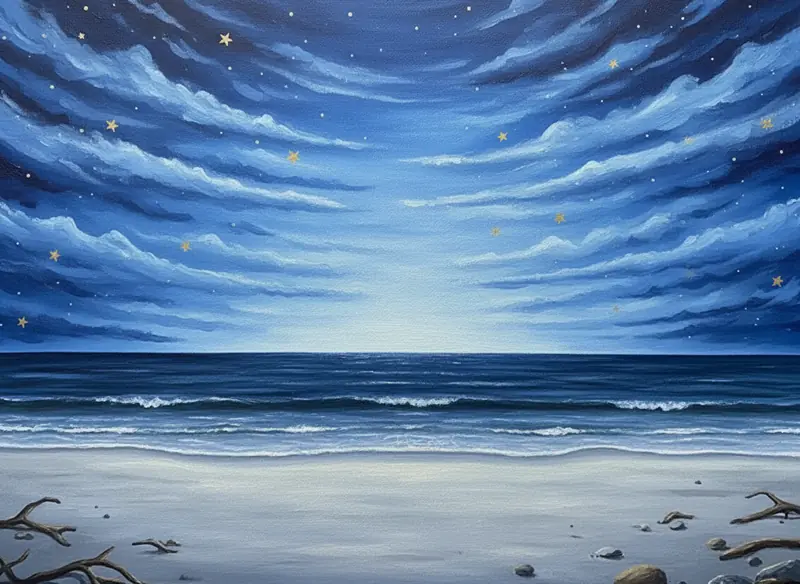
| Beach at night | Reflection, loneliness, something you are facing in private |
| Walking alone on the beach | Processing; time with yourself that you want or lack |
| Walking with someone | The relationship at a threshold |
| Crowded beach | Other people's demands; feeling seen or hemmed in |
| Deserted beach | Solitude, isolation, or peace, by your feeling |
| Big wave coming | A feeling or event about to arrive that you cannot stop |
| Tsunami on the beach | Overwhelm; a change that rewrites everything |
| Beach with no water | Something drained; a loss of feeling or of a source |
| Lost on the beach | Not knowing which direction a transition is taking |
| Beach house | A self that lives at the boundary; a wish for a life by the water |
| Finding shells or treasure | Small discoveries about yourself in a quiet period |
| Searching for someone on the beach | Fear of losing a person in a change |
A calm, sunny beach
The gentle version is the one most people wake from well. Warm sand, clear shallows, a flat horizon. In dream interpretation it is read as rest and settlement: a conflict closed, a decision made, a week in which nothing was asked of you. People report it on the first nights of a holiday and in the days after finishing something long.
It also appears as a wish. If you were on the beach but could not relax, or kept checking your phone, or had to leave, the dream is naming a rest you need and have not taken. Burnout dreams often look like this: paradise with a knot in it. Ask what is keeping you off the sand in waking life.
A beach at sunset adds an ending, often a gentle one. A beach at sunrise adds a start. Both tend to come near the edge of a chapter.
A stormy, dark or empty beach
When the sky turns, the dream has changed subject. A storm rolling in over the water is emotion you can see coming: a diagnosis waiting, a conversation scheduled, a relationship that will not hold. You are still on the sand, which means you are watching it rather than in it, and that is worth noting.
A beach at night is quieter and more inward. Dreamers who are grieving, deciding something privately or lying awake with a worry get the dark shore. The moon on the water tends to make it reflective rather than frightening; total dark makes it a dream about not seeing where the next step lands.
A deserted beach cuts two ways. If the emptiness felt like peace, you have the solitude you wanted or need it. If it felt like abandonment, you are at a threshold with nobody beside you. The emotion you woke with decides.
A beach with no water, the tide gone impossibly far out, is one of the stranger versions and one of the most telling. Something that used to be full has drained: a passion, a relationship, a reserve of energy.
Walking on the beach, alone or with someone
Walking is the beach dream's most common action and the one most people skip over.
Alone, it is processing. The rhythm of walking, the line of the waterline, the horizon: the dream gives you time with yourself and nothing to do. Footprints behind you that the water erases are a common detail, and they tend to be about what you leave behind in a change.
With someone, the dream puts a relationship at the threshold. A partner beside you on the sand is the relationship itself standing between the known and the unknown: a move, a child, a hard year. An ex on the beach is a relationship you have not finished thinking about, meeting you at the one place where you look at feelings. A parent, especially one who has died, often appears here, since the beach is where many families spent their rarest good days.
Walking with a dog adds loyalty and simplicity. Walking and never arriving anywhere, the same stretch repeating, is a transition that will not resolve.
Swimming, waves and the water coming in
Once you leave the sand the dream becomes a water dream, and the beach is only its frame.
Swimming from the shore reflects how you are coping: confident strokes, exhaustion, going out further than you meant to. A wave that knocks you down is a feeling or event that arrived harder than you expected and left you standing. A big wave building on the horizon is a familiar anxious dream, and tidal waves appear on standard typical-dream questionnaires: something you can see coming and cannot stop, a bill, a result, a conversation.
A tsunami on the beach is the extreme version, and it usually follows a change that will rewrite everything, or the fear of one: a breakup, a layoff, a diagnosis in the family. Where you were when it came, running inland, on a roof, frozen on the sand, says how you expect to meet it. Drowning off the beach brings the same overwhelm closer to the body.
The tide coming in slowly while you sit is a quieter cousin: pressure accumulating while you stay put. Rising water in any dream tends to carry that message.
A crowded beach, a nude beach and being seen
The beach is one of the few places adults stand half-dressed among strangers, and the dreams know it.
A crowded beach where you cannot find a spot reflects a life full of other people's claims: a packed calendar, a house with no privacy, a job where you are never off. It can also be about comparison. Beach dreams in which you look at other bodies, or feel looked at, often follow a stretch of self-consciousness about ageing, weight or a new relationship.
Being naked on a beach, or at a nude beach, is less about sex than about exposure: a secret coming out, a vulnerability shown to people you did not choose. If nobody in the dream minded, you are more at peace with being seen than you think.
Beach house, cliff and watching from a distance
Where you stood relative to the water is the dream's way of saying how close you are to the feeling.
A beach house, with the sea through the window, is a self that lives at the boundary and is comfortable there. People dream it when they have found a way to hold feeling and routine at once, or when they wish they had. A ruined or flooded beach house is that balance failing.
Watching the shore from a cliff or a bridge is distance. You see the whole scene and feel none of it, which is either wisdom or avoidance depending on your week. A lighthouse in the dream adds guidance: something or someone showing you where the rocks are.
Being on a Boat just off the beach, unable to land, is wanting to arrive somewhere stable and not being let in.
Animals and objects on the beach
Creatures change the scene. A Crab on the sand is something small with a hard shell and a sideways way of moving, often a person. A seagull is noise or scavenging. A starfish or a seashell you picked up is a small find in a quiet period: an insight, a memory, a piece of yourself washed up. A shark in the shallows is a danger where you came to rest, usually a person in a place that should be safe. A turtle coming ashore to lay eggs is one of the gentlest beach images and tends to appear around slow, patient projects.
Lost keys or a phone on the beach are practical life intruding on rest; sandcastles are plans you know will not last.
Spiritual and biblical meaning of a beach in a dream
The Bible has no beaches in the holiday sense, but the shore is where several of its turning points happen, and Christian dream interpreters build on them. Jesus calls the first disciples on the shore of Galilee and, after the resurrection, cooks them breakfast on the beach (John 21). Jeremiah 5:22 speaks of the sand as the boundary God set for the sea, a line the waves cannot cross. Paul's shipwreck lands him on the beach of Malta (Acts 27-28). From these, a beach in a dream is read as a place of calling, of safe limits, and of landing after a storm.
In the dream tradition attributed to Ibn Sirin the sea stands for a ruler or for the world's affairs, and standing safely at its edge is being near power or trouble without being swallowed. Many coastal cultures treat the shore as a liminal zone, neither land nor sea: in Afro-Brazilian religions, which draw on the Yoruba orisha Yemoja, it belongs to Iemanjá, mother of the waters, and offerings are made there at the turn of the year. Jung's reading of the sea as the unconscious makes the beach the edge of what you know about yourself.
Treat these as traditions, which show what the image has meant to people, not as predictions of what the dream will bring.
Is a beach dream good or bad?
Mostly a mood report. Dream researchers classify dreams by content and emotion rather than omen, and the feeling you woke with is the best guide. Rested: the dream was rest, or a wish for it. Wistful: a threshold, something ending or about to. Anxious: the water did something, and the question is which feeling you can see coming. Exposed: the dream is about being seen, and who was watching matters.
No study links beach dreams to coming travel, wealth or love, whatever a dreambook promises. If the same dream repeats, write down the water, the light, where you stood and who was there, and compare the versions. The detail that changes is usually the live question. If the beach dream is a recurring nightmare, a wave that never finishes breaking, imagery rehearsal therapy, rewriting the ending while awake, has good evidence for recurring nightmares.
Questions people ask
What does it mean to dream about a beach?
A beach in a dream usually marks a threshold between everyday life and what you feel: the sand is the practical side, the sea the emotional one. A calm, sunny shore follows rest or a decision made; a stormy, dark or crowded one follows pressure. The water's state, the light, where you stood and who was with you set the reading.
What does it mean to dream of walking on the beach alone?
It is a processing dream. Walking the waterline gives you time with yourself and nothing to do, and it appears both in people who have no such time and in people who just took it. Footprints the water erases often point to what you are leaving behind in a change. If the walk felt lonely rather than peaceful, you are at a threshold without company.
What does a stormy beach in a dream mean?
Emotion you can see coming: a result, a conversation, a relationship that will not hold. You are still on the sand, which means you are watching it rather than in it. Many of these dreams end before the storm lands, which is how the waking situation feels. Ask which feeling is on the horizon this month.
What does it mean to dream of big waves at the beach?
A wave building on the horizon is something you can see arriving and cannot stop. A wave that knocks you down is a feeling or event that hit harder than expected and left you standing. A tsunami is overwhelm, a change that rewrites everything. Where you were when it came says how you expect to meet it.
What is the spiritual meaning of a beach in a dream?
Traditions read the shore as a sacred edge. In Scripture it is where disciples are called and where Paul lands after the storm; Jeremiah calls the sand the boundary set for the sea. Coastal religions treat it as a liminal zone between worlds, and Jung reads it as the edge of the unconscious. These are lenses for reflection, not predictions.
What does it mean to dream of a beach at night?
A quieter, more inward version. It comes to people who are grieving, deciding something in private or lying awake with a worry. Moonlight on the water makes it reflective; total dark makes it a dream about not seeing where the next step lands. Note who, if anyone, was with you.
Why do I keep dreaming about the beach?
Recurring dreams track an unresolved waking theme. If the shore keeps returning, you are standing at a boundary you have not crossed: a decision, an ending, a rest you keep postponing. Compare the versions and watch the water and the light; the detail that changes is the live question. Distressing recurring versions respond to imagery rehearsal therapy.
The bottom line
The beach dream meaning comes down to a line between the solid and the felt, and where you stood on it. A calm shore follows rest or a settled decision; a stormy, dark or drained one follows pressure, grief or depletion. Walking alone is processing, walking with someone puts the relationship at a threshold, and a crowd or a bare body turns the dream toward being seen. Waves, tides and tsunamis bring the sea's feeling onto the sand. Scripture and coastal traditions read the shore as calling, safe limits and a sacred edge; none promise events. Note the water, the light, your place on the sand and the feeling you woke with, and the dream usually points to one boundary you are already standing on.

Clinical psychologist in private practice in Minnesota who works with adults on anxiety, stress and sleep problems, including recurring nightmares.
Sources
- Domhoff, G. W. (2003). The Scientific Study of Dreams. American Psychological Association.
- Walker, M. P., & van der Helm, E. (2009). Overnight therapy? The role of sleep in emotional brain processing. Psychological Bulletin.
- Nielsen, T. A., et al. (2003). The Typical Dreams of Canadian University Students. Dreaming.
- Krakow, B., & Zadra, A. (2006). Clinical Management of Chronic Nightmares: Imagery Rehearsal Therapy. Behavioral Sleep Medicine.
- Jung, C. G. (1964). Man and His Symbols.