

Key takeaways
- Flower dreams often mirror growth, affection and the stage a situation has reached.
- Blooming flowers lean toward hope; wilted or dead ones toward loss or fatigue.
- Giving or receiving flowers points to how you show and accept feelings.
- Color and kind of flower add detail; the dream doesn't predict love, a wedding or a death.
Your dream
A reflection, not a prediction
You’ve had today’s free interpretation on this browser. Sign up with Apple or Google to keep it and get more.
Read the full interpretation — free
This is the first part of your interpretation. Create a free account to read the rest.
Sign up and this dream and its interpretation are saved to your journal. Otherwise they’re deleted in 24 hours. No card, no subscription.
On this page
What do flower dreams mean?
A flower grows, opens, peaks and fades in a short time. That cycle makes it a natural picture of anything you nurture: a relationship, a project, your own confidence. Flowers also carry feeling. People give them to say love, thanks and sorry, so dreams about flowers often deal with emotions you want to express.
Growth
Buds and blooms can reflect a plan, a skill or a bond that is starting to open.
Love and appreciation
A bouquet or a single stem often stands for affection, given or wished for.
Beauty and self-image
Flowers can mirror how attractive or noticed you feel.
Time and endings
Wilted petals remind you that every season passes, including the hard ones.
Why flowers appear in your dreams
Dreams reuse what you saw and felt. If you walked through a park in spring, bought flowers or went to a wedding or funeral, the dream may simply replay it. Flowers also affect mood when awake: in a study by Jeannette Haviland-Jones and colleagues, people who received flowers showed genuine smiles and reported better mood days later. That link between flowers and feeling makes them easy for the dreaming mind to borrow.
Sigmund Freud used one of his own dreams, about a botanical monograph, to show how a single flower image can tie together many waking memories. You can use the same method: list what the flower reminds you of.
What in your life is in bloom right now, and what is starting to fade?
Common flower dream scenarios
| Dream | What it often reflects |
|---|---|
| Flowers blooming | A new phase, hope, confidence that grows |
| Dead flowers | Disappointment, an ending, energy that ran out |
| Receiving flowers | Feeling valued, wish for recognition or love |
| Giving flowers | Wanting to express affection, thanks or an apology |
| Picking flowers | Choosing what to keep, enjoying a moment |
| Planting flowers | Patient effort, hopes for the future |
| A flower garden | Your inner life, a home or relationship you tend |
| Flowers on a grave | Grief, remembrance, honoring the past |
Blooming, wilted and dead flowers
Blooming flowers are the most hopeful version. Watching a bud open can mirror a talent, relationship or plan finally showing results. A field of flowers can feel like abundance and rest.
Wilted flowers often appear when you feel tired or neglected, or when you have neglected something yourself. Ask what you stopped watering: a friendship, a hobby, your health. Dead flowers can mark an ending you already know about. They can also stand for grief, and dreams of a wreath or flowers at a cemetery often follow a loss or an anniversary.
Artificial or plastic flowers raise a different question: is something in your life only looking alive?
Receiving or giving flowers in a dream
Receiving flowers turns the dream toward recognition. Flowers from a partner can mirror feeling loved, or a wish to feel loved more. Flowers from an ex may stir old feelings or unfinished business. Flowers from a stranger often feel like a surprise compliment from life.
Giving flowers points to what you want to say. If you hand someone flowers and they refuse, the dream may mirror fear that your feelings won't be welcome. Bridal flowers, like a bride's bouquet, add commitment and the hopes around it.
Where the flowers grew
The place adds a layer to the dream.
- Inside your home: a vase of fresh flowers can mirror warmth and care in your household. Flowers growing through the floor or walls suggest feelings that won't stay contained.
- In your hair or on your clothes: attention to how you look, a wish to be seen, or a celebration you are part of.
- Growing from your body: a strange image. It often reflects a creative idea or a change that comes from deep inside you.
- Among weeds: something good surviving in a messy situation, or a hope you have to protect.
- In winter or snow: resilience, beauty that appears when you least expect it.
Bees and butterflies on the flowers bring work and change into the picture. A bee visiting blooms links the dream to patient effort that pays off; a butterfly adds transformation.
Flower colors in dreams
| Color | What it often reflects |
|---|---|
| Red | Passion, love, strong emotion, sometimes anger |
| White | Peace, innocence, new starts; in some cultures mourning |
| Yellow | Friendship, joy, optimism |
| Pink | Tenderness, gentle affection, care |
| Purple | Spiritual interest, dignity, mystery |
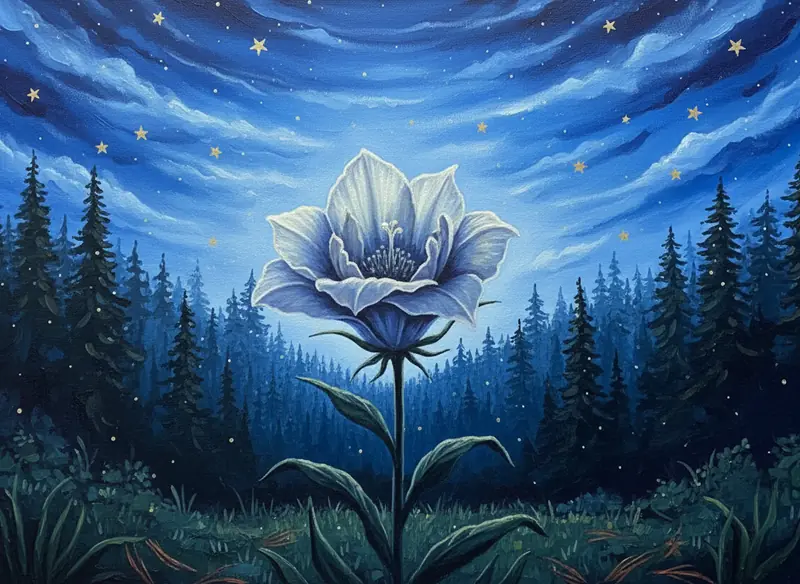
| Blue | Calm, longing, something rare |
Roses, lilies, lotus and other flowers
- Rose: love and beauty, with thorns that remind you of risk. A red rose is the classic image of romance.
- Lily: purity, peace and, in many Western funerals, remembrance.
- Lotus: in Hindu and Buddhist art the lotus rises clean from muddy water, so it often stands for growth through hard times.
- Sunflower: warmth, loyalty and turning toward what feeds you.
- Tulip, daisy, orchid: fresh starts, simple joy and rare beauty.
In the Victorian "language of flowers," each bloom had a coded meaning. Those codes are tradition, but they show how long people have used flowers to speak.
Spiritual and biblical meaning of flowers
In the Bible, Jesus points to the lilies of the field in Matthew 6:28–29: they don't labor, yet Solomon in all his splendor was not dressed like one of them. For Christian dreamers, flowers can carry trust and care. In Buddhism the lotus stands for awakening. In Mexico, marigolds decorate altars on the Day of the Dead, and in parts of Europe chrysanthemums belong to funerals, so the same flower can mean joy in one culture and grief in another.
Treat these as traditions, not rules. The spiritual meaning of a flower dream depends on your beliefs and on how the dream felt.
Questions people ask
Is it good luck to dream about flowers?
A flower dream doesn't bring luck. Many traditions see flowers as a good sign, but in dream interpretation they reflect your feelings about growth, love and change.
What does it mean to dream of someone giving you flowers?
It often mirrors feeling appreciated or wanting recognition from that person. If the giver surprised you, look at how you feel about them now.
What do dead flowers mean in a dream?
Dead flowers usually point to disappointment, an ending or neglect. They can also follow grief and reflect remembrance.
What is the spiritual meaning of flowers in dreams?
Many faiths use flowers as images of beauty, care and renewal: the lilies of the field in the Bible, the lotus in Buddhism and Hinduism.
What does a garden full of flowers mean in a dream?
It often reflects a period of abundance, rest or emotional richness, or a wish for one.
What does it mean to dream of picking flowers?
Picking flowers often reflects choosing what matters to you, or enjoying a good moment while it lasts. If you picked too many or they wilted in your hands, you may be grasping at something that needs time.
The bottom line
A flower in your dream usually reflects something you nurture and how it is doing. Blooming flowers tend to mirror hope, growth and affection. Wilted or dead ones point to fatigue, disappointment or a chapter that has closed. Start with the state of the flowers, who gave or received them and how you felt, then ask what in your life needs attention or celebration. If the dream stays with you, describe it in full and read it as one story.

Clinical psychologist in private practice in Minnesota who works with adults on anxiety, stress and sleep problems, including recurring nightmares.
Sources
- Haviland-Jones, J., Rosario, H. H., Wilson, P., & McGuire, T. R. (2005). An environmental approach to positive emotion: Flowers. Evolutionary Psychology, 3(1).
- Domhoff, G. W. (2017). The invasion of the concept snatchers: The origins, distortions, and future of the continuity hypothesis. Dreaming, 27(1).
- The Bible, Matthew 6:28–29 (NIV).
- Goody, J. (1993). The Culture of Flowers. Cambridge University Press.
- Freud, S. (1900). The Interpretation of Dreams.