

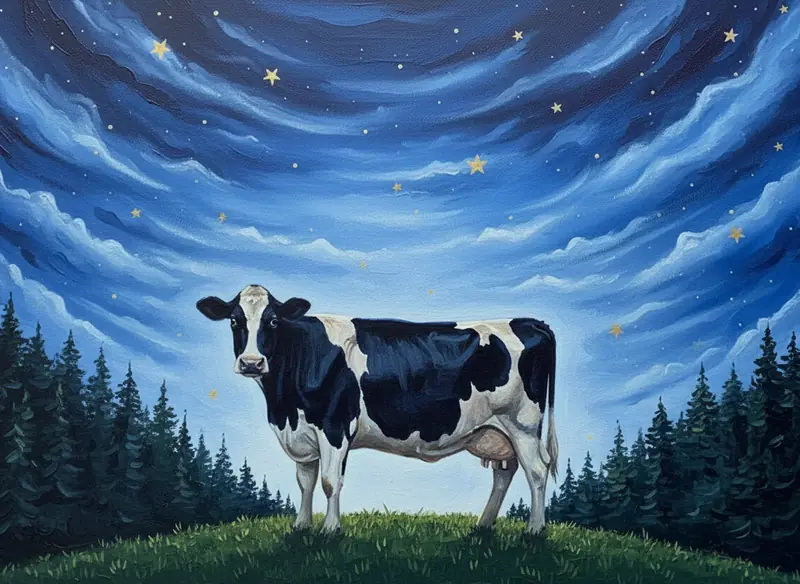
Key takeaways
- Cow dreams usually point to nourishment, caregiving, patience or the resources you rely on.
- The animal's condition matters: healthy and calm, thin, sick, charging or giving birth each say something different.
- In Genesis and the Quran, fat and lean cattle stand for years of plenty and scarcity; in Hinduism the animal is sacred.
- No research shows that these dreams predict money, pregnancy or bad luck.
Your dream
A reflection, not a prediction
You’ve had today’s free interpretation on this browser. Sign up with Apple or Google to keep it and get more.
Read the full interpretation — free
This is the first part of your interpretation. Create a free account to read the rest.
Sign up and this dream and its interpretation are saved to your journal. Otherwise they’re deleted in 24 hours. No card, no subscription.
On this page
What does it mean to dream about cows?
Few animals carry as much everyday meaning. A dairy animal gives milk, grazes slowly and lives in a group, and for thousands of years farming families measured their security in cattle. When you dream about cows, your mind tends to borrow from that picture. Four readings come up again and again in dream interpretation; start with the one that matches how the dream felt.
Care and nourishment
This animal feeds others. In the dream it can stand for your mother, a partner who looks after you, or your own role as the person who keeps everyone going.
Steady resources
Cattle were wealth on the hoof. A healthy herd can mirror a sense that you have enough; a bony one, worry about money, time or energy.
Patience and calm
Grazing animals move slowly and chew for hours. A peaceful heifer in a pasture can reflect a wish to slow down, or a rest you have finally taken.
Going along with the herd
Cattle follow each other. If you were one of many, the dream may ask where you are doing what others expect of you.
These readings overlap. A tired animal you keep milking can mean care and depletion at once; a calm herd you walk through can mean rest and belonging.
Why cows show up in dreams
G. William Domhoff's research supports the continuity view: dreams follow the people, places and concerns of waking life. If you grew up on a farm, drove past fields last week or poured milk this morning, the explanation may be that simple. Children's books, dairy ads and county fairs keep the image close even for city dwellers.
Matthew Walker and Els van der Helm describe REM sleep as overnight emotional processing. That helps explain why a quiet, gentle animal turns up when you feel drained: your brain reaches for an image of care when care is the issue.
Questions to ask before you interpret
- Was the animal calm, thin, sick, aggressive or giving birth?
- Was it alone or part of a herd?
- Were you milking, feeding, petting, running away or watching?
- Where were you: a field, a barn, a city street, your own house?
- Did you feel comfort, worry, fear or tenderness?
If this animal were someone in your life right now, who would it be, and is that person being fed or drained?
Cow dreams by what happened
| Dream | What it often reflects |
|---|---|
| A calm heifer grazing | Rest, contentment, a steady stretch |
| Being chased or charged | Pressure from family, duty or a role you resist |
| Milking | Drawing on a resource, or giving a lot of yourself |
| Cow giving birth | A new project, role or responsibility taking shape |
| A thin or sick animal | Feeling depleted, or worry about having enough |
| A dead one | A source of support that ended or ran dry |
| Hugging a cow | A need for comfort and simple care |
| Killing a cow | Ending a dependence or a role that fed others |
Dreaming of a cow chasing or attacking you
A charging heifer surprises people because the animal looks so gentle. The dream often reflects pressure that comes from a soft place: a parent's expectations, caregiving that has grown too heavy, guilt about saying no. It sits close to being chased dreams, and Antti Revonsuo's threat-simulation theory suggests your brain rehearses the escape while you sleep. If the animal had horns and a heavy neck, think of a bull: that reading leans toward anger, strength or open confrontation.
Notice whether you got away. Climbing a fence or stepping aside often matches a waking situation where you already see a way out. If the animal cornered you, ask who in your week makes you feel you cannot refuse.
Cow dreams with a whole stampeding herd add numbers to the pressure: several duties or people pushing at once, often around family events, holidays or a move. Being trampled tends to come with burnout, while watching the herd pass from a safe spot suggests you see the rush without being swept up in it.
Milking, giving birth and calves
Milking in a dream ties directly to giving and receiving. If the milk flowed easily, you may feel your effort pays off. If the animal kicked or gave nothing, you may be asking too much of one source, or of yourself. Spilled milk tends to bring frustration over small losses that pile up.
A birth or a calf often appears when something new needs your care: a child, a business, a student, a younger colleague. These dreams are common during pregnancy, but they do not predict one. A baby cow on its own may point to your own need to be looked after for a while.
Thin, sick or dead cows
A bony or sick animal often mirrors depletion: too little sleep, too much giving, savings running low. A dead one seldom relates to a real death. It usually marks the end of a support you relied on, like a job, a parent's help or a routine that kept you steady. If the dream arrived during grief, it may carry that loss in a gentler form than a human figure would.
Colours in cow dreams
Colour shifts the tone. A black cow often carries the same themes with more mystery or worry. A white one tends to feel calm or sacred, especially for people raised in Hindu households. A golden cow can echo the golden calf of Exodus and ask what you are placing too much value on. Brown and spotted animals are the everyday version, closest to farm memories and childhood picture books.
Biblical, Islamic and Hindu meaning
The best known cattle dream in history is Pharaoh's in Genesis 41: seven fat cows come out of the Nile, then seven thin ones eat them. Joseph reads them as seven years of plenty followed by seven of famine. The Quran tells the same dream in Surah Yusuf (12:43). For readers of either book, fat and lean cattle still carry that sense of abundance and scarcity, and a dream of starving animals may echo worries about the future.
In Hinduism the animal is sacred and linked to Kamadhenu, the wish-granting mother of plenty; many families in India read such a dream as a blessing. Ancient Egypt pictured the goddess Hathor with a cow's head or horns. We present these as traditions. None of them turns a dream into a forecast, and the spiritual meaning you take from one is yours to weigh.
When to talk to someone
Most cow dreams are mild, and many people remember them as oddly peaceful. If yours come back with fear, or point again and again to exhaustion from caring for others, it may be time to share the load. Talk with someone you trust, or with a therapist if the stress follows you into the day.
Questions people ask
What does it mean when you dream about cows?
Most often it reflects nourishment and support: caring for others, being cared for, or how secure your resources feel. A calm herd suggests stability; a thin or sick animal suggests you feel drained.
Is it good luck to see a cow in a dream?
Many traditions, especially in Hinduism, treat this dream as a blessing. Research does not show that dreams bring luck or money. The dream tells you more about how supported or stretched you feel.
What is the biblical meaning of cows in a dream?
In Genesis 41, Pharaoh dreams of seven fat cows eaten by seven thin ones, and Joseph reads them as years of plenty and famine. For people of faith, a dream of fat or lean cattle may echo hopes or worries about provision.
What does it mean to dream of a cow chasing you?
It often points to pressure from a gentle source: family expectations, caregiving or guilt about saying no. Your brain rehearses threats during sleep; the dream does not mean harm is coming.
What does it mean to dream of a cow giving birth?
It usually reflects something new that needs your care, such as a project, a role or a relationship. These dreams are common in pregnancy, but they do not predict one.
What does a dead cow mean in a dream?
It rarely relates to a real death. It more often marks the end of a support you relied on, or a period of exhaustion.
The bottom line
A cow dream usually reflects care, steady resources and patience: who feeds whom, and whether there is enough. A calm animal or a healthy herd often appears in settled periods; a thin, sick or charging one when you feel depleted or pushed. Births and calves point to something new that needs care. Note what happened and how you felt, match it to your week, and treat the stories of Pharaoh and Kamadhenu as tradition rather than prediction.

Clinical psychologist in private practice in Minnesota who works with adults on anxiety, stress and sleep problems, including recurring nightmares.
Sources
- Domhoff, G. W. (2003). The Scientific Study of Dreams. American Psychological Association.
- Walker, M. P., & van der Helm, E. (2009). Overnight therapy? The role of sleep in emotional brain processing. Psychological Bulletin.
- Revonsuo, A. (2000). The reinterpretation of dreams: An evolutionary hypothesis of the function of dreaming. Behavioral and Brain Sciences.
- The Bible (NIV). Genesis 41.
- The Quran. Surah Yusuf 12:43.