

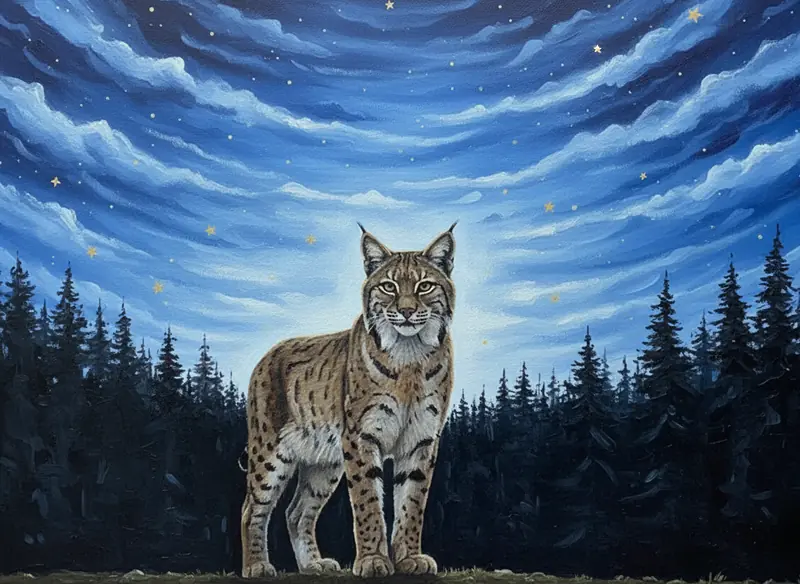
Key takeaways
- Bobcat dreams usually point to independence, watchfulness, or a threat you noticed early.
- A calm bobcat and a charging one are different dreams; distance and behaviour decide the reading.
- The bobcat is a solitary hunter that avoids people, so it often appears when you want to be left alone.
- Bobcats range from southern Canada to Mexico, so many dreamers have seen or heard of one nearby.
- No evidence links bobcat dreams to omens, enemies or coming danger.
Your dream
A reflection, not a prediction
You’ve had today’s free interpretation on this browser. Sign up with Apple or Google to keep it and get more.
Read the full interpretation — free
This is the first part of your interpretation. Create a free account to read the rest.
Sign up and this dream and its interpretation are saved to your journal. Otherwise they’re deleted in 24 hours. No card, no subscription.
On this page
What does a bobcat dream mean?
The bobcat is a mid-sized wild cat of North America: roughly twice the size of a house cat, spotted, with tufted ears and the short tail that gives it its name. It hunts alone, mostly at dusk and dawn, and most people who share land with bobcats have never seen one. That profile shapes the bobcat dream meaning more than any dream book does. When one turns up in your sleep, one of these four readings usually fits.
Self-reliance
Bobcats do not travel in groups. A bobcat in your dream can mirror a stretch of life where you are handling things alone, by choice or not, and doing it competently.
A threat you saw first
You rarely see a bobcat unless it lets you. Spotting one in a dream often reflects noticing a risk before others did: a shift at work, a change in someone's tone.
A wish for distance
Bobcats avoid people. If the cat in your dream kept its distance and so did you, the dream may be about wanting space from family, a partner or a crowd.
Instinct under control
A bobcat is all patience until it strikes. Dreaming of one can reflect anger or desire you are holding steady, waiting for the right moment or hoping it passes.
These readings overlap. A bobcat sitting on a rock watching you is not the same dream as one lunging at your dog. The sections below sort out the details.
Why a bobcat, and not a house cat?
Dreams choose their animals from what you know and what you fear. Dream researchers such as G. William Domhoff call this the continuity hypothesis: dreams draw on the people, places and concerns of your waking life. Bobcats range from Mexico to southern Canada, with most of them in the United States, and many people have seen one cross a road, heard one at night or read a neighbourhood warning about them. The image is available in a way that a leopard or a tiger is not.
The second reason is the wildness. A Cat in a dream carries independence and intuition, but it also carries your sofa. A bobcat strips the domestic part away. It is the same cat with no owner, no name and no need of you. When your mind wants an image for independence that does not ask permission, this is a good one.
Antti Revonsuo's threat simulation theory offers a third angle: dreams rehearse how we respond to danger. A bobcat is a believable, mid-level threat, dangerous enough to take seriously and small enough to face. That makes it a useful stand-in for the problems that are real but not overwhelming.
What to notice in your dream
Before you look up a scenario, answer these:
- How close did it come? Across a field, on your porch, in your house, on top of you?
- What was it doing? Watching, stalking, hunting, resting, running away, attacking?
- How did it look? Healthy and sleek, or thin, injured, caged?
- How did you feel? Afraid, calm, protective, curious, honoured?
- Who else was there? A pet, a child, a partner, nobody?
If the bobcat were a person in your life, or a part of you, who or what would it be?
Keep your first answer. Then check the scenarios.
Common bobcat dream scenarios
| Dream | What it often reflects |
|---|---|
| A bobcat watching from a distance | Something you are aware of but not yet dealing with |
| A bobcat near your house | A worry approaching your private life |
| A bobcat attack | A conflict that feels sudden and personal |
| Being chased by a bobcat | A problem you keep avoiding |
| A calm or friendly bobcat | Peace with your own independence |
| A bobcat and your pet | Fear for someone or something you protect |
| Bobcat kittens | A new, vulnerable start that still has claws |
| A dead or injured bobcat | A threat that has passed, or independence that has cost you |
A bobcat watching you
The most common version, and often the calmest. The cat sits at the edge of the yard or on a ridge and looks at you. Nothing happens. This usually matches a waking situation you are aware of and watching back: a risk at work, a person whose motives you are still reading. Neither of you has moved yet.
A bobcat near or in your house
A House in dreams often stands for you or your family. A wild cat on the porch or in the kitchen points to a worry that has come closer to home than you like. If it was inside, ask what has got into your private life recently that does not belong there.
A bobcat attack
Being attacked by a bobcat feels fast and personal, the way these dreams usually do. It often reflects a conflict that caught you off guard, or a fear that a quiet person in your life will turn on you. If you fought back, you may be more ready to defend yourself than you think. The Attack page covers animal attacks in general.
Being chased by a bobcat
Chase dreams share one theme: something you avoid while awake. With a bobcat as the chaser, that thing is usually something you noticed early and then put down. For the chase itself, see being chased.
A calm or friendly bobcat
A bobcat that lets you near, or that walks beside you, is a dream many people remember fondly. It often reflects a truce with your own need for solitude, or a sign that something wild in you has become something you can live with.
A bobcat and your pet or child
Bobcats do take small pets, and people who live near them know it. A dream where the cat threatens your Dog, your cat or your child usually carries fear for someone who depends on you, and the sense that the danger is quiet and close.
Bobcat kittens
Kittens with spots and tufted ears are a soft image with a hard edge: small now, wild later. The dream can reflect a new project, relationship or phase that looks harmless and will grow teeth. It can also point to a protective instinct of your own.
A dead, injured or caged bobcat
A dead bobcat often marks a threat that has passed or an instinct you have shut down. A caged one is more pointed: independence that someone, maybe you, has locked up. Ask what you have stopped yourself from doing lately.
Bobcat, lynx, cougar: does the species matter?
People often wake unsure which cat they saw. The differences are small in biology and larger in feeling.
- Bobcat. Compact, spotted, cautious. Dreams about one lean toward watchfulness and self-reliance.
- Lynx. The bobcat's northern cousin, with bigger paws and longer ear tufts. In dreams it carries the same themes with more cold and distance, and in European folklore it stands for seeing what is hidden.
- Mountain lion or puma. Much larger and more dangerous. Dreams about one are usually about power and a threat you cannot handle alone.
- Panther or jaguar. Darker, more exotic, more often about desire, secrecy and the night.
If you are not sure, go with the feeling. A cat that felt manageable was probably a bobcat, whatever your dream called it.
What psychology says about wild cat dreams
Jung and the instinctive self
Carl Jung read animals in dreams as images of instinct: the parts of the psyche that act without asking the conscious mind. A wild cat specifically carries the instinct to stay apart, to watch, and to strike only when sure. If you have been forcing yourself to be sociable, agreeable or available, a bobcat can be the part of you that has had enough.
Continuity and recent experience
Most dreams continue waking concerns, so the useful question is what in your life looks like this animal right now. People who live where bobcats roam may dream of them after a sighting or a warning, and those dreams need less interpretation than the ones that arrive from nowhere.
Gestalt: speak as the bobcat
Fritz Perls suggested voicing each part of a dream. Try it: "I am the bobcat on your fence. I am here because..." Finish without planning. With a wild cat dream, some people hear themselves say something about wanting to be left alone.
Spiritual and cultural readings
Traditions read the bobcat with respect and a little suspicion. We show these as traditions, not predictions.
| Tradition | How the bobcat is often read |
|---|---|
| Native American stories | A patient hunter; in some tales paired with Coyote as opposites, the wildcat with fog and Coyote with wind; meanings vary by nation |
| Shawnee story | The bobcat's spots explained by a trick: Rabbit gets it to build a fire, and the scattered coals singe its coat |
| Modern animal-totem writing | A keeper of secrets; solitude, silence, trusting your own perception |
| Christian folk readings | No bobcat in scripture; wild beasts generally read as trials or wilderness |
| Popular Islamic dream books | Cats, wild or tame, often read as a thief or a hostile person |
Spiritual meaning of a bobcat
Modern spiritual writers usually call the bobcat a teacher of solitude and perception: it sees in low light, moves without sound and does not need company. If the dream felt like a visit rather than a threat, that reading may suit it. Treat it as a mirror of what you value, not a message from outside.
Biblical meaning
The Bible does not mention bobcats, which live only in the Americas. Christian dream readers who address wild cats generally fold them into the image of wilderness: a place of testing where you are alone with what you believe.
What to do after a bobcat dream
- Write it down before the day starts. "Bobcat, fence, dusk" is enough.
- Note the distance. How close it came often maps to how close the waking issue is.
- Name the feeling in one word.
- Ask what you noticed this week before anyone else did, and what you did about it.
- Check your need for space. If the cat kept its distance, do you want some too?
Bobcat dreams are rarely true nightmares. If wild animal dreams keep returning and leave you dreading sleep, imagery rehearsal, where you rewrite the dream with a new ending while awake, has good evidence behind it. A therapist can help you set it up.
Related dreams
- Wild animals: instinct in general, without a species.
- Lion: pride and public power, the bobcat's opposite in visibility.
- Fox: another solitary hunter, read for cunning rather than patience.
- Kitten: softness and dependence, what the bobcat kitten grows out of.
- Forest and desert: the places bobcats live, and what they mean on their own.
Questions people ask
What does it mean to dream about a bobcat?
It usually reflects self-reliance, watchfulness or a threat you noticed before others did. A calm bobcat often points to peace with your own independence; a stalking or attacking one to a conflict or risk that feels close.
Is a bobcat in a dream good or bad?
Neither. It shows how you relate to independence and to quiet threats right now. Traditions and modern totem writers read the bobcat as a patient hunter or a keeper of secrets, not as an omen.
What does a bobcat attack mean in a dream?
A sudden, personal conflict, or fear that someone quiet will turn on you. If you fought back in the dream, you may be more ready to stand your ground than you feel awake.
What is the spiritual meaning of a bobcat in a dream?
In Native American stories the bobcat often appears as a patient hunter, and a Shawnee tale explains its spots; modern totem writers read it as a keeper of secrets, solitude and trusting your own perception. These are traditions, not forecasts.
What is the difference between dreaming of a bobcat and a lynx?
Little in biology, more in feeling. The lynx carries the same themes with more cold and distance, and in European folklore it stands for seeing what is hidden. Go with the feeling the dream left.
The bottom line
A bobcat in your dream is usually a picture of something quiet and capable: a side of you that handles things alone, a risk you spotted early, or a wish to be left in peace. Start with how close the cat came and what it did, then ask what in your life matches. If it attacked, look for a conflict that surprised you. If it watched, look for the thing you are watching too. The dream is not an omen of enemies. It is a portrait of how you are keeping your distance, and whether that still serves you.
Related symbols

Clinical psychologist in private practice in Minnesota who works with adults on anxiety, stress and sleep problems, including recurring nightmares.
Sources
- Smithsonian's National Zoo and Conservation Biology Institute. Bobcat.
- Jung, C. G. (1964). Man and His Symbols. Doubleday.
- Domhoff, G. W. (2018). The Emergence of Dreaming: Mind-Wandering, Embodied Simulation, and the Default Network. Oxford University Press.
- Revonsuo, A. (2000). The reinterpretation of dreams: An evolutionary hypothesis of the function of dreaming. Behavioral and Brain Sciences, 23(6).
- Krakow, B., & Zadra, A. (2006). Clinical management of chronic nightmares: Imagery rehearsal therapy. Behavioral Sleep Medicine, 4(1).